idfg-badge

Idaho Fish and Game

anglers in lewiston

Clearwater Region Spring Chinook Update 4/23/2026

idfg-jthiessen

Greetings folks,  

The 2026 spring Chinook salmon season opens Saturday, April 25. Throughout the season, Idaho Fish and Game will provide weekly updates covering the Clearwater River Basin, Rapid River Run (Lower Salmon and Little Salmon Rivers), and the Hells Canyon Run (Snake River). These updates will summarize run size, dam counts, harvest shares, fishing success, and any changes to seasons or limits. Because conditions can change quickly, anglers are encouraged to check the most current regulations before heading out.(Click Here for current Chinook Season and Limits) 

WHAT’S NEW THIS SEASON 

The IDFG Commission has granted the Director authority to expand spring Chinook fishing seasons and limits in-season. This complements the Director’s existing authority to reduce or close spring/summer Chinook fisheries as needed. These actions no longer require an emergency Commission meeting, allowing for quicker and more responsive management decisions. 

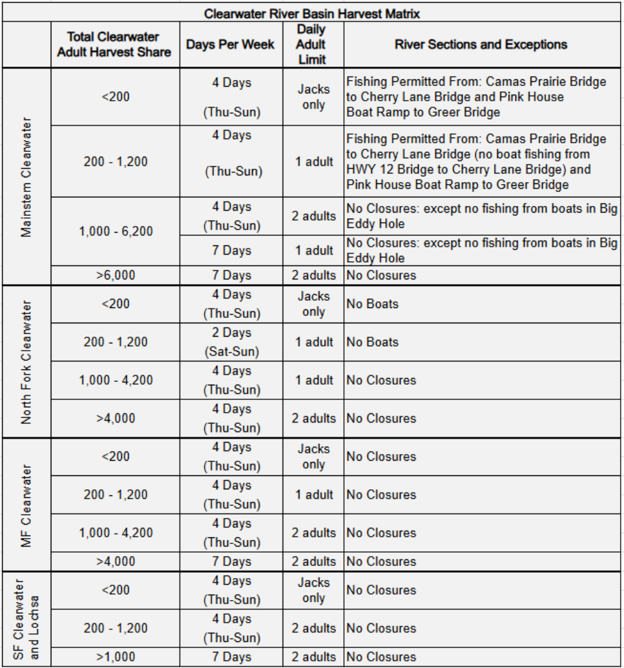
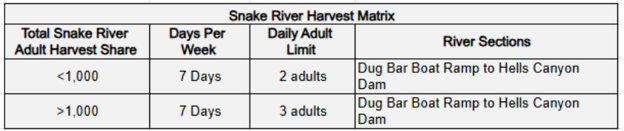
All adjustments will follow Commission-approved season structure tables (shared below). This added flexibility is a benefit for anglers. If the run exceeds preseason expectations, seasons can be expanded more quickly to maximize harvest opportunity. Conversely, The Director already had the authority to reduce or close a season if the run returned weaker than forecasted, this ensures broodstock needs are met and impacts to wild fish remain minimal.
Clearwater Matrix
Snake River Matrix

SEASON AND LIMITS 

Seasons and limits for 2026 follow long-standing harvest matrix guidelines developed through extensive public input. These frameworks are designed to provide more opportunities when returns are strong and more conservative fisheries when returns are weak. Given the current forecast, most fisheries are starting with moderate restrictions intended to balance harvest opportunity with season length. As the run develops, Idaho Fish and Game will adjust days per week, bag limits, or open areas as needed to respond to actual run strength. 

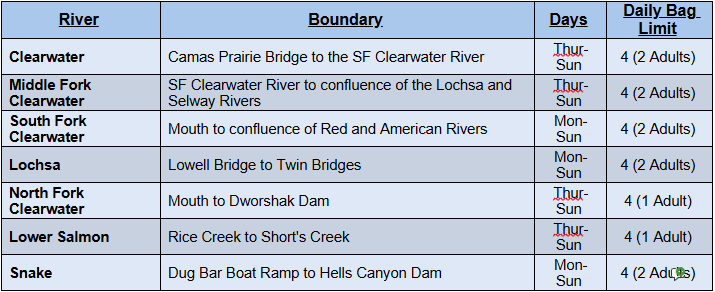
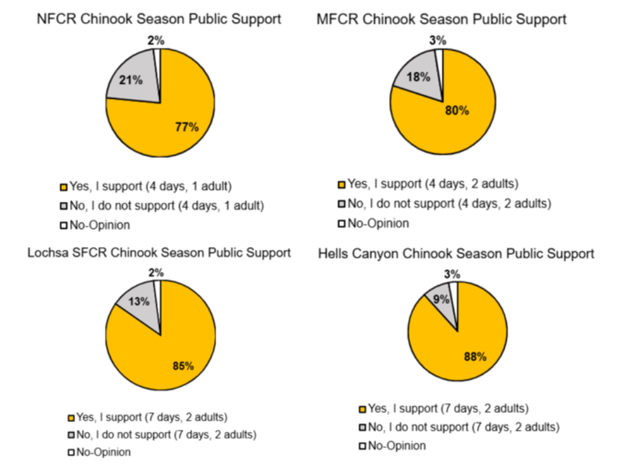
IDFG fisheries staff received public input on the department’s season and limit recommendations back in February. All recommendations were supported by the majority of anglers, and I am happy to report that these recommendations were approved by the IDFG Commission during the March Commission Meeting (click the hyperlink to view). Below you will find the Spring Chinook season and limits to start the 2026 fishery: 

Season Structure

For the most up to date season and rules for each Idaho Chinook fishery, please visit the Spring Chinook Fishing Season and Rules page on IDFG’s website.  

Clearwater Fisheries 

Recognizing that the 4-day, 2-adult season is a new addition to the Clearwater salmon fishery, I want to share the results of our public input and explain the objectives behind this strategy. During the season-setting process, fisheries staff asked anglers which characteristics of a Chinook fishery were most important. Results showed an almost even split between “harvesting the full allocation (reaching harvest share)” and “maximizing the number of fishing days per week” (see figure below). 

These preferences directly support the current objectives outlined in the Clearwater Fisheries Management Plan and guided the development of this season structure. 

opinion survey Chinook

Clearwater Basin harvest data from the past 10 year's show that a 7-day, 1-adult fishery performs similarly to a 4-day, 1-adult fishery. Regardless of run size, both structures consistently left about 20% of the harvest share unutilized each year. Over a five-year period, that equates to roughly 3,900 adult Chinook, nearly double this season’s total harvest allocation. 

When examining harvest patterns across the basin, deficits were most evident in the mainstem Clearwater pass-through fishery and in more remote areas like the South Fork Clearwater and Lochsa rivers. The two strongest factors influencing whether the sport fishery reaches its harvest share are daily bag limit and river conditions (flow). 

So, what does this mean? 

A 1-adult daily limit, whether applied to a 4-day or 7-day fishery, combined with low river flows results in reduced angling effort, lower catch rates, and ultimately underharvested shares. Many anglers have experienced this first-hand, which has led to calls for a 7-day, 2-adult season. However, that level of harvest power is too high and fish would be harvested too quickly, shortening the season and limiting how opportunity is distributed across the basin. 

To strike a balance between harvest efficiency and season duration, while maintaining opportunity throughout the region, the 4-day, 2-adult structure was recommended. 

Rapid River Fisheries 

The Lower Salmon and Little Salmon fisheries maintain strong harvest power under all conditions due to consistently high and concentrated fishing pressure. As a result, more conservative season structures are necessary during low to moderate run sizes to meet fishery objectives. 

However, because run timing and river conditions can influence fish arrival and wild fish impacts, some flexibility was built into the management framework. Similar to the Clearwater season-setting approach, fisheries managers incorporated overlap between harvest share categories within the Rapid River matrix (see below). This allows for greater in-season flexibility to distribute harvest more effectively while minimizing impacts to wild fish. 

Based on this strategy, the IDFG Commission approved a 4-day-per-week, 1-adult daily limit for the Lower Salmon and Little Salmon rivers. 

Public Comment Results 

Rather than explaining in text all the results, below you will find the result summaries from this season’s spring chinook public comment period.

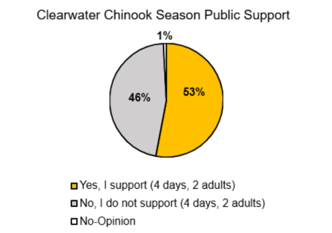
Clearwater Opinion
public survey CLRW

The 4-day, 2-adult fishery in the Clearwater was supported by the majority of anglers. However, the numbers only tell part of the story. Many anglers who did not support the recommendation still agreed with the strategy but noted that a 7-day fishery would better fit their work schedules. Others suggested rotating open days during a 4-day fishery to more fairly distribute opportunity for those who do not work a traditional Monday–Friday schedule. 

To those anglers, your input is heard. We are already developing questions for next year’s public comment period to better understand preferred fishing days. In addition, staff are modeling harvest under alternative structures, including a 5-day fishery and weekend-focused or weekday-focused season, to evaluate the potential tradeoffs of each approach. 

More to come as we continue refining these fisheries.

rapid river response

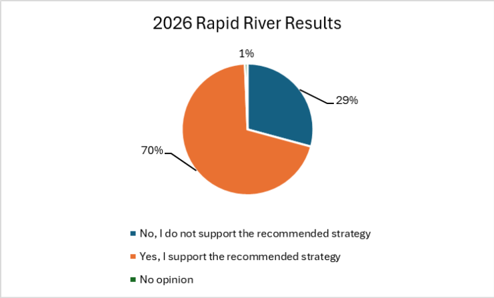
It’s important to note that a large majority of anglers supported continuing to allocate harvest share between the Lower and Little Salmon fisheries. In response, managers will aim to distribute the Rapid River harvest with approximately 55% allocated to the Lower Salmon River and 45% to the Little Salmon River. 

THE 2026 FORECAST 

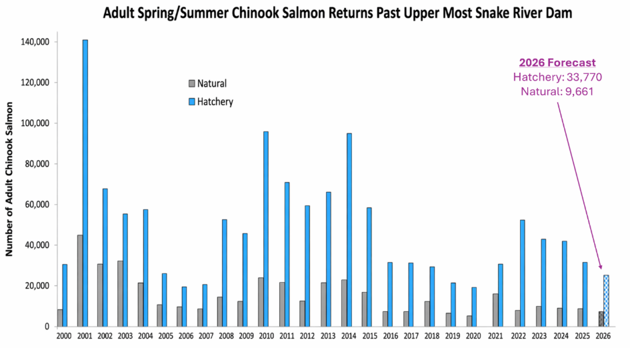
The 2026 forecast for adult spring and summer Chinook passing Lower Granite Dam is below the recent 10-year average, continuing a trend of moderate to low returns. The hatchery forecast is 33,770 adults, while the natural-origin forecast is 9,661 adults, both lower than in recent years. 

This forecast is based on returning jacks from 2025. As always, forecasts carry uncertainty, and we will gain a clearer picture of the run as fish begin returning to Bonneville Dam. 

forecast

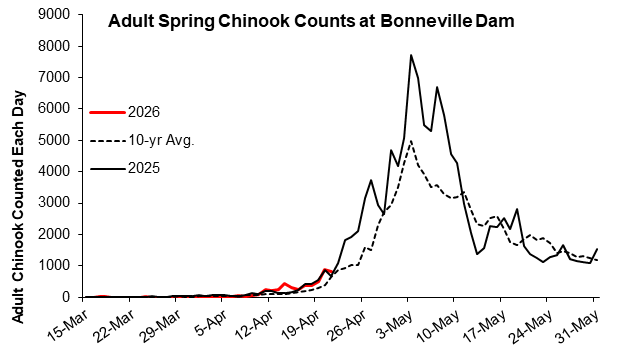
Speaking of fish at Bonneville Dam, early-season counts at Bonneville are tracking near average. This is an encouraging sign. Regardless of the forecast, I’m sure everyone is hoping for a run on par, or better than last season. Time will tell.  

As of April 22, 2026, a total of 5,870 adult Chinook have passed Bonneville Dam, closely tracking both last year’s counts and the 10-year average for this date. While it’s still early and forecasts remain uncertain, there is reason for cautious optimism as the season gets underway.

Bonneville Counts

The preseason forecasted harvest shares are as follows: Clearwater Basin: 2,003 adults; Rapid River: 1,923 adults; and Hells Canyon: 378 adults. The Lochsa River has an additional preseason share of 174 adults. These numbers may change as the run develops, but they represent our starting point for the season. 

If you’re wondering whether it’s worth fishing opening weekend, that’s ultimately up to you. At this time, only a handful of fish have passed Lower Granite Dam, so catch rates are likely to be limited early on. 

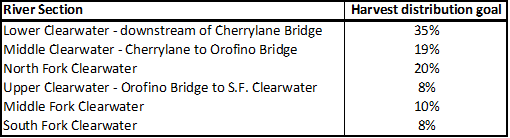
As harvest begins, updates will include data showing which sections of river are producing fish and how close each fishery is to meeting its allocation. As a reminder, Clearwater Basin harvest allocations are provided below. 

Harvest Allocation

With lower flows projected this spring, Chinook are expected to move from Bonneville Dam to Idaho faster than usual. For anglers targeting the Lower Salmon River, fish typically take 7–10 days to move from Lower Granite Dam to the start of the fishery at Rice Creek Bridge under average conditions. 

Keep an eye on flows, once the Lower Salmon River pushes above 50,000 cfs, migration can slow significantly as fish work through Slide Rapid. In lower flows, expect fish to jet through the deep channel of the river, as they’re not being pushed into softer shoreline waters. The projected spring flows may create tough fishing for bank anglers, hopefully this isn't the case, but low flows historically haven’t led to good catch rates for bank anglers.  

Bottom line, fish are on the move, and the season is knocking on the door. 

Get your gear ready. Make a plan. Springer season is here, go get ’em!!! 

THE NEW JOE 

Some of you may have already noticed this update comes from a different Joe. I’m Joe Thiessen, the new Fisheries Manager for the Clearwater Region. 

I want to recognize the strong foundation built by former Regional Fisheries Manager Joe DuPont. Many of the tools, outreach efforts, and management strategies we rely on today, including season structure tables, harvest allocation approaches, and stakeholder engagement, were developed under his leadership. His approach, which emphasized balancing opportunity across diverse user groups, has helped shape the modern salmon fishery in this region. 

Stepping into this role comes with high expectations, and I’m both honored and motivated to build on that foundation as we continue managing these fisheries for the benefit of anglers. I look forward to collaborating with anglers, hearing outside-the-box ideas, and working through the challenges that come with managing dynamic fisheries. This role carries significant responsibility, and I’m committed to making thoughtful, transparent decisions that support both the resource and the people who depend on it.