
idfg-badge

Idaho Fish and Game

Chinook salmon at Lower Granite trap

Lower Granite Dam counts say one thing, but catching says another: Fall Chinook report

idfg-mdobos

A large number of Chinook arriving in late summer are trapped for hatchery broodstock

Fall Chinook salmon anglers who are keeping an eye on window counts at Lower Granite Dam might not be aware of why fishing near Lewiston and Clarkston in late summer doesn't always match up to their expectations. To have a successful hatchery program that continues to bring adult fall Chinook back to the Snake River, adult fish are collected for broodstock at Lower Granite Dam. 

As fish are counted and move upstream through the fish ladder, some of those fish get trapped and processed by a crew made up from several agencies including the Idaho Fish and Game, Washington Department of Fish and Wildlife and NOAA Fisheries. A fall Chinook working group dedicates a lot of time trying to answer a variety of questions before fall trapping starts at Lower Granite Dam. 

These questions include:

  • How many adults are needed to make broodstock goals?
  • How many big fish are needed to ensure we retain those genes in the future?
  • How many natural fish (non-hatchery reared) are needed?
  • How do we ensure we do not handle more steelhead than is necessary?
  • What is the best way to meet program goals?

As you can imagine, coming up with such a plan is complicated and can change as the season develops. For this year, the plan was to start trapping 70% of the fish coming through the ladder from Aug. 18 through Sept. 7 and then drop the trap rate to 16%. The trap does not have the ability to select certain species, so it’s a catch-all of everything in the ladder. This is why it is important to look at how many total fish are going to need to be handled. 
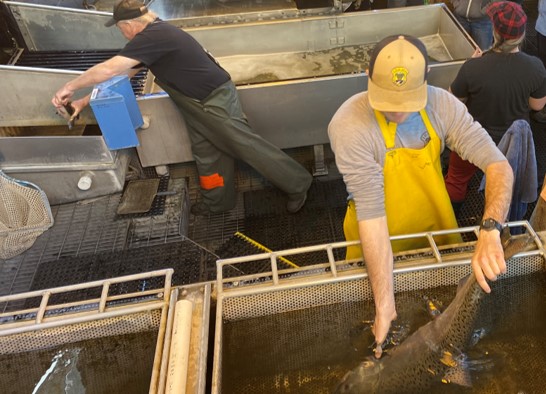
Chinook, trapping, Lower Granite Dam

Trapping during this early part of the season allows the team to collect a fair number of large fall Chinook, many of which are natural-origin fish. This strategy also means that the high trap rate does not trap as many steelhead because they tend to arrive slightly later than fall Chinook at Lower Granite Dam. 

Unfortunately, river conditions are warm in the Columbia River, and both fall Chinook and steelhead timing to Lower Granite Dam are later than expected. There were also fewer larger fish than expected. With a later run timing and fewer big fish being trapped, extending the high trap rate was necessary to ensure enough adults are collected to meet broodstock goals. 

As of the end of trapping on Sept. 9, a total of 2,532 adult fall Chinook have been collected for broodstock at Lower Granite Dam, and 2,129 adults and jacks were returned to the river. The broodstock goal is approximately 4,000 adult fish that are at least 28 inches in length. 

Collection of broodstock fish will continue at Lower Granite Dam and during the season, further adjustments might still occur, such as modifying the trap rate or size criteria if the expected return to Lower Granite Dam changes. A lower trap rate is needed to reduce the amount of fish being trapped and handled when more fish are expected to arrive. With numbers of fall Chinook and steelhead starting to bump up at Ice Harbor Dam, the trap rate was lowered to 16% on Sept. 9 so more fish should be coming your way. 

If you have any questions regarding the fall Chinook salmon program and the trapping that occurs at Lower Granite Dam, feel free to contact Fish and Game Fisheries Biologist Marika Dobos (marika.dobos@idfg.idaho.gov), the Regional Manager Joe DuPont (joe.dupont@idfg.idaho.gov), or other staff at the Lewiston Regional Office by email, or call (208) 750-5010.