The fall Chinook Salmon season in the Snake River basin opened on August 18, and good numbers of fish are starting to enter Idaho. So, I thought it would be good to send out an update to share with you what we are learning and whether any changes in the season may occur in the future.
Run Status
Fall Chinook Salmon passage over Bonneville Dam is nearing completion (about 90% complete), and as such, we have a good understanding of how many fish bound for the Snake River basin will return from the ocean this year. It looks like this year’s return past Bonneville Dam will be about 36,000 adult fish which is lower than the preseason forecast (about 47,000 fish). Regardless, this size of return is large enough to provide some exciting fishing opportunities.
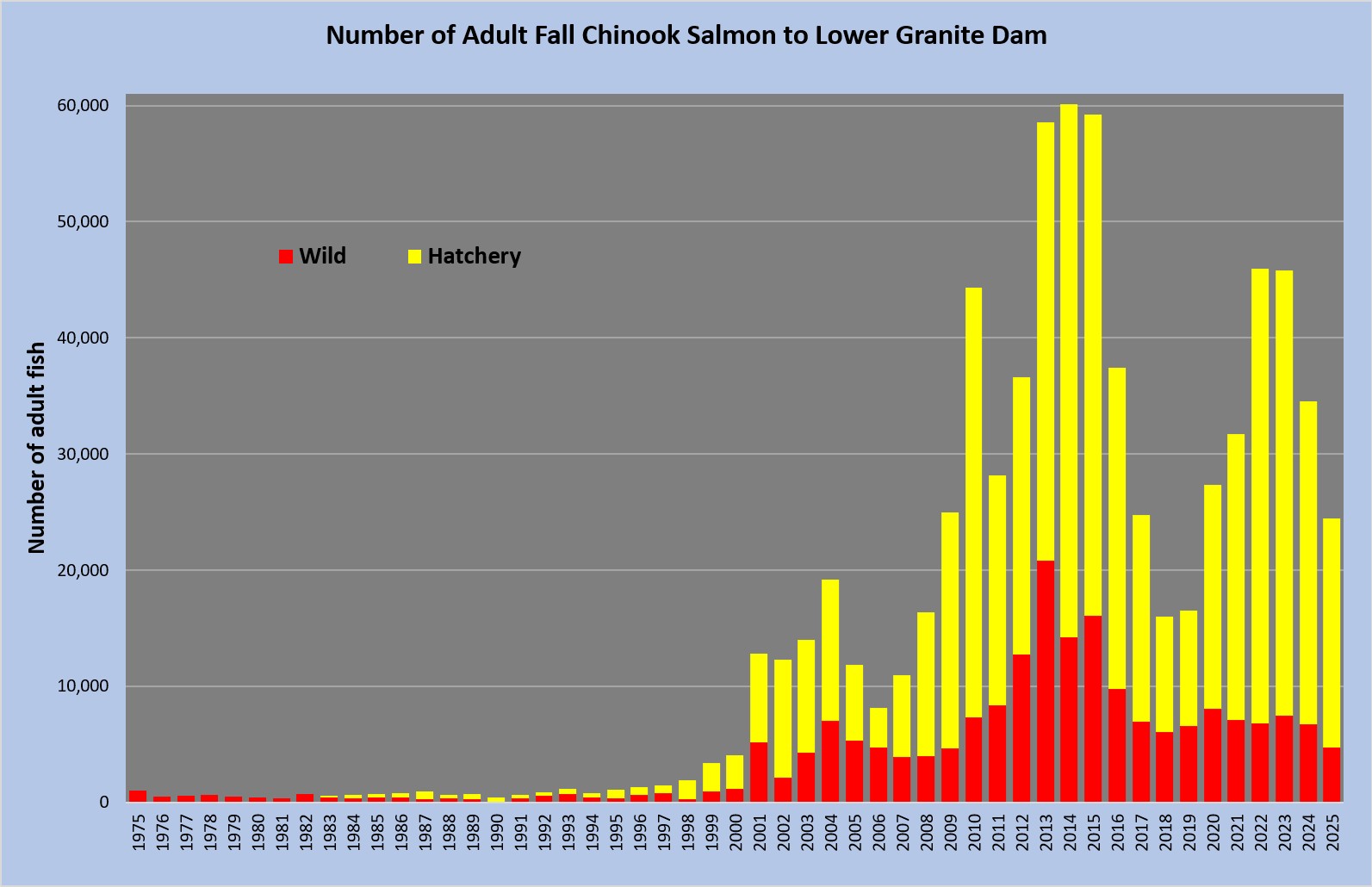
A troubling issue we are seeing this year is the fall Chinook Salmon are taking longer to migrate to Lower Granite Dam than has occurred in the past. This is troubling because the slower these fish migrate the fewer that tend to make it to Idaho. Most suspect this slow migration is due to the warm water temperatures occurring in the Columbia and Snake rivers. At this point, we don’t know how many fall Chinook Salmon will make it to Idaho, but in years when we saw slower travel times, survival rates during their migration from Bonneville Dam to Lower Granite Dam approached 50%. This year the migration rates are the slowest we have seen since we started PIT tagging these fish. As such, we fear their survival rate could even be less than 50%. If we assume the survival rate this year will be 48%, about 24,000 adult fall Chinook Salmon would make it to Lower Granite Dam (see 2025 bar in figure below). If this survival rate is accurate, it would come in considerably below the 10-year average (34,000 adult fish). Additionally, the adult wild return to Lower Granite Dam would be around 4,700 fish which is the lowest we have seen since 2009 (see figure below).