idfg-badge

Idaho Fish and Game

muledeerbuck1030102.jpg

Hunter Harvest Report: Elk and mule deer keep on climbing in 2025

idfg-cliess

An EHD outbreak in summer 2025 might’ve contributed to a drop in whitetail harvest.

It’s that time of year again. As we foam at the mouth anticipating which hunting units, weekends, and drainages to scope out this fall, here’s a summary of how last fall went, thanks to hunter harvest reporting.

Let’s kick off this year’s harvest summary with the one species that didn’t see an increase from the previous year: whitetails.

White-tailed deer harvest typically hovers around the 22,000 mark, and last year’s harvest wasn’t too far off from that. Hunters still have room for celebration, as the year’s harvest could’ve looked a lot different—but more on that in a bit. 

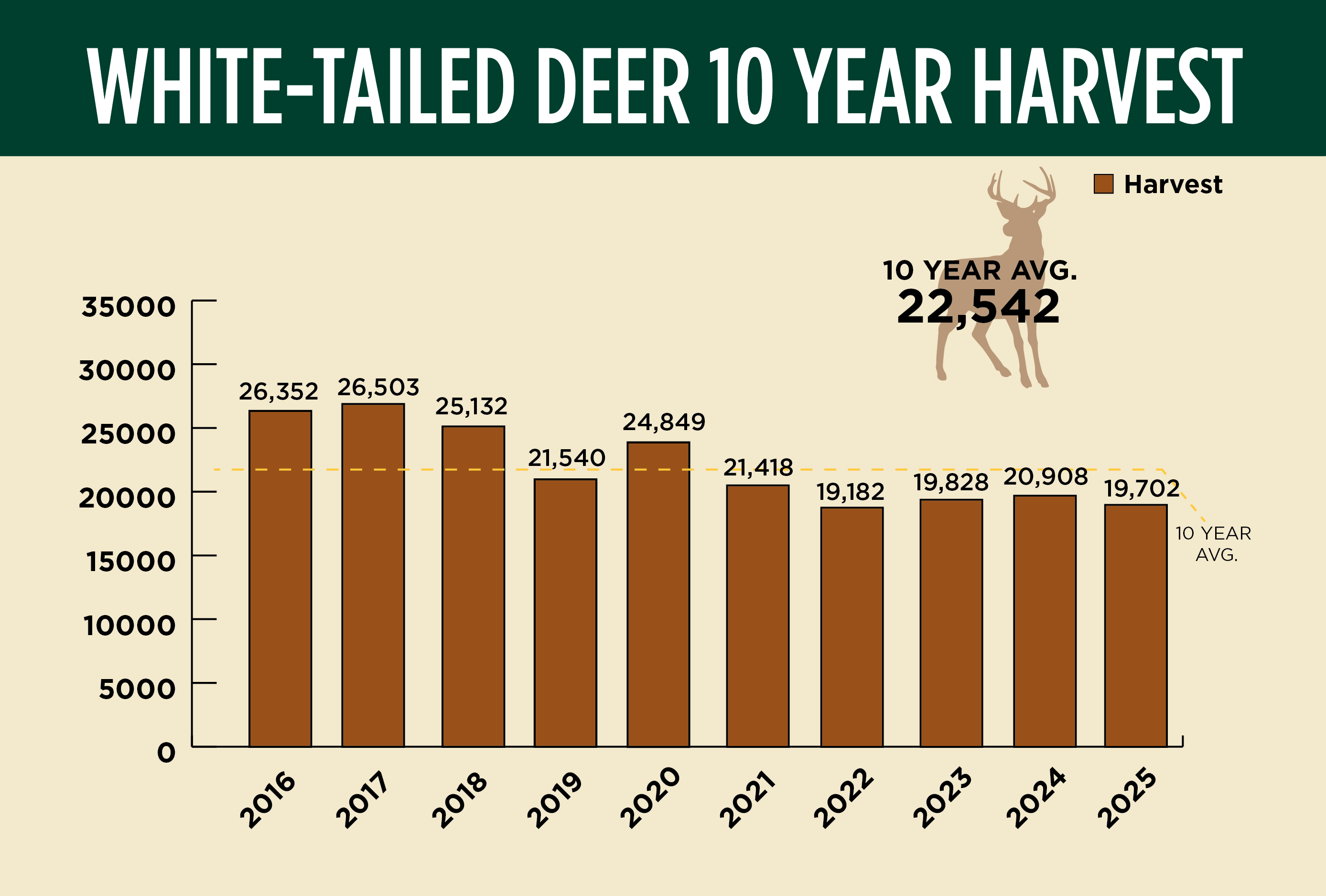
Last year’s 19,702 whitetail harvest still sits right in line with the 10-year average, which despite a handful of EHD outbreaks during the past decade, still continue to flourish. Despite slipping a bit from the 2024 hunter harvest, last fall’s harvest has Fish and Game biologists nodding their heads with optimism as we round out the final weeks of winter and approach this year’s hunting season.
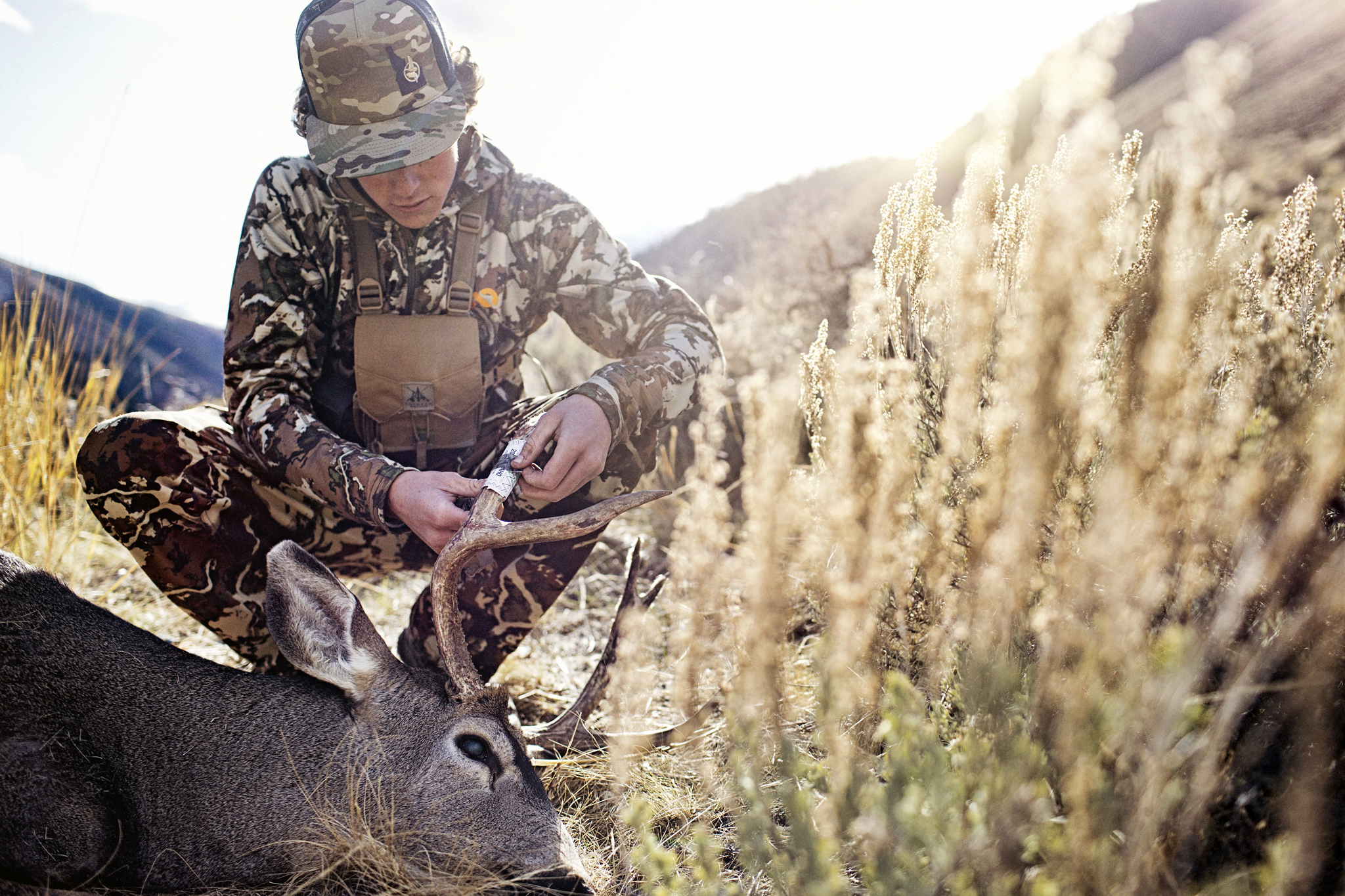
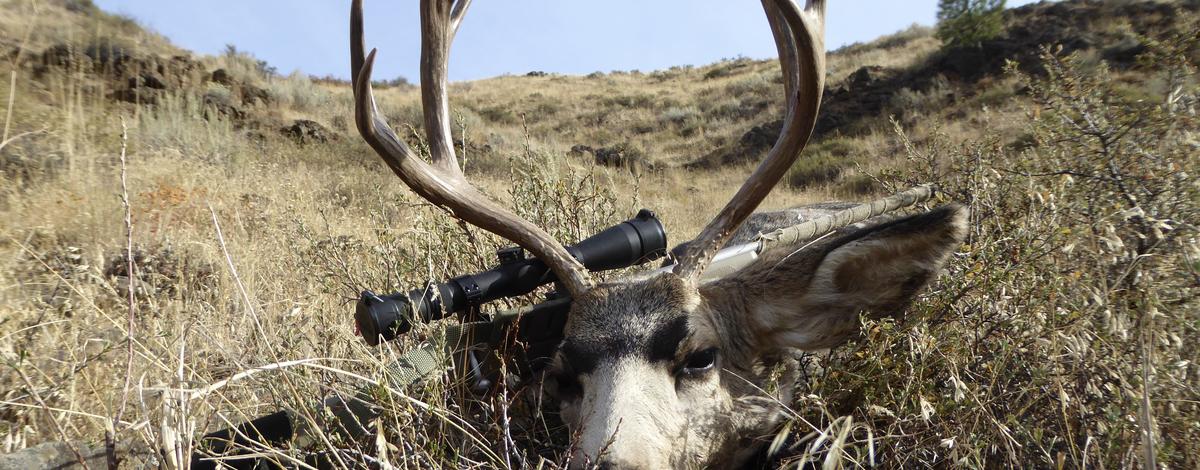
young male hunter standing over and tagging mule deer buck

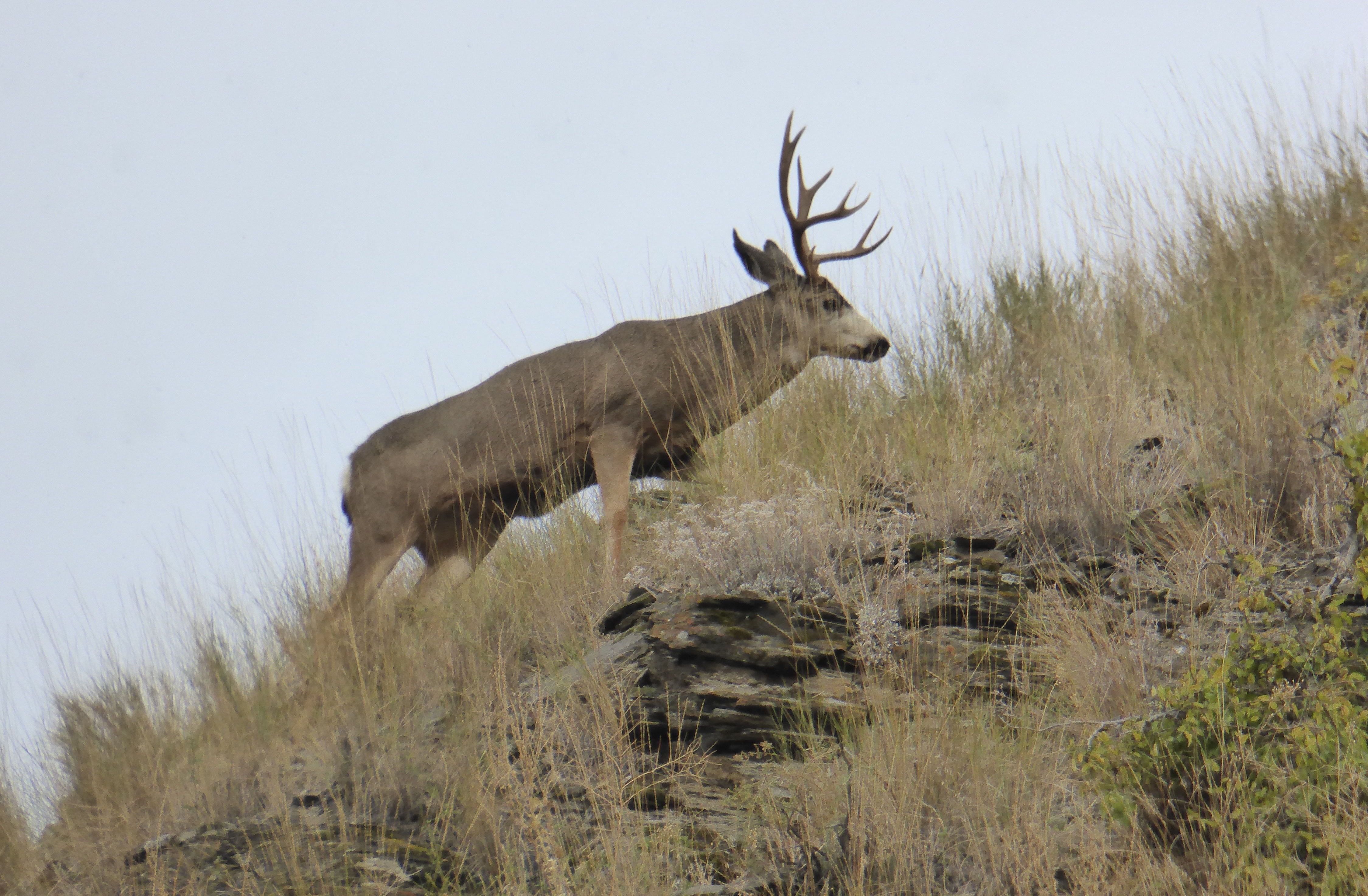
Mule deer (or, technically speaking, mule deer hunters) are the biggest winners from the 2025 fall season. Harvest of muleys jumped 2.8% from 2024, or put another way, 691 more animals during this past year’s harvest. That’s worth noting, considering some of the state’s population had a rough go of it during the winter of ’22 and ‘23. 

Fortunately for them, the past few Idaho winters have been some of the mildest in recent years, including this past winter which (for now) has been Club Med for mule deer. But as Fish and Game biologists point out, mild to nonexistent winters can have reverse effects come later in the summer.

Finally, on to elk. 

Elk hunters also had a successful fall, accounting for a 2.4% increase (or 509 animals) from 2024. As we’ve covered every year in these annual reports, elk don’t feel the impact of weather nearly as bad as their long-eared or white-tailed cousins.

Last year’s harvest landed at 101% of the 10-year average (21,249), which makes it about as close to a “normal” harvest as you can get with fluctuating annual harvests.

ELK

By the numbers

  • Total elk harvest in 2025: 21,505
  • 2024 harvest total: 20,996
  • Overall hunter success rate: 23%
  • Antlered: 13,263
  • Antlerless: 8,242
  • Taken during general hunts: 13,524 (18% success rate)
  • Taken during controlled hunts: 7,981 (40% success rate)

How it stacks up

There’s nothing exactly to write home about if you look at last year’s elk harvest. Across the board, harvest totals and success percentages are pretty standard when compared to the previous nine years. Sure, there might be a 2-3% increase/decrease from year to year, but in the grand scheme of things, that’s marginal. And remember, these numbers pour in from every corner of the state—not one specific elk zone or hunting unit. 

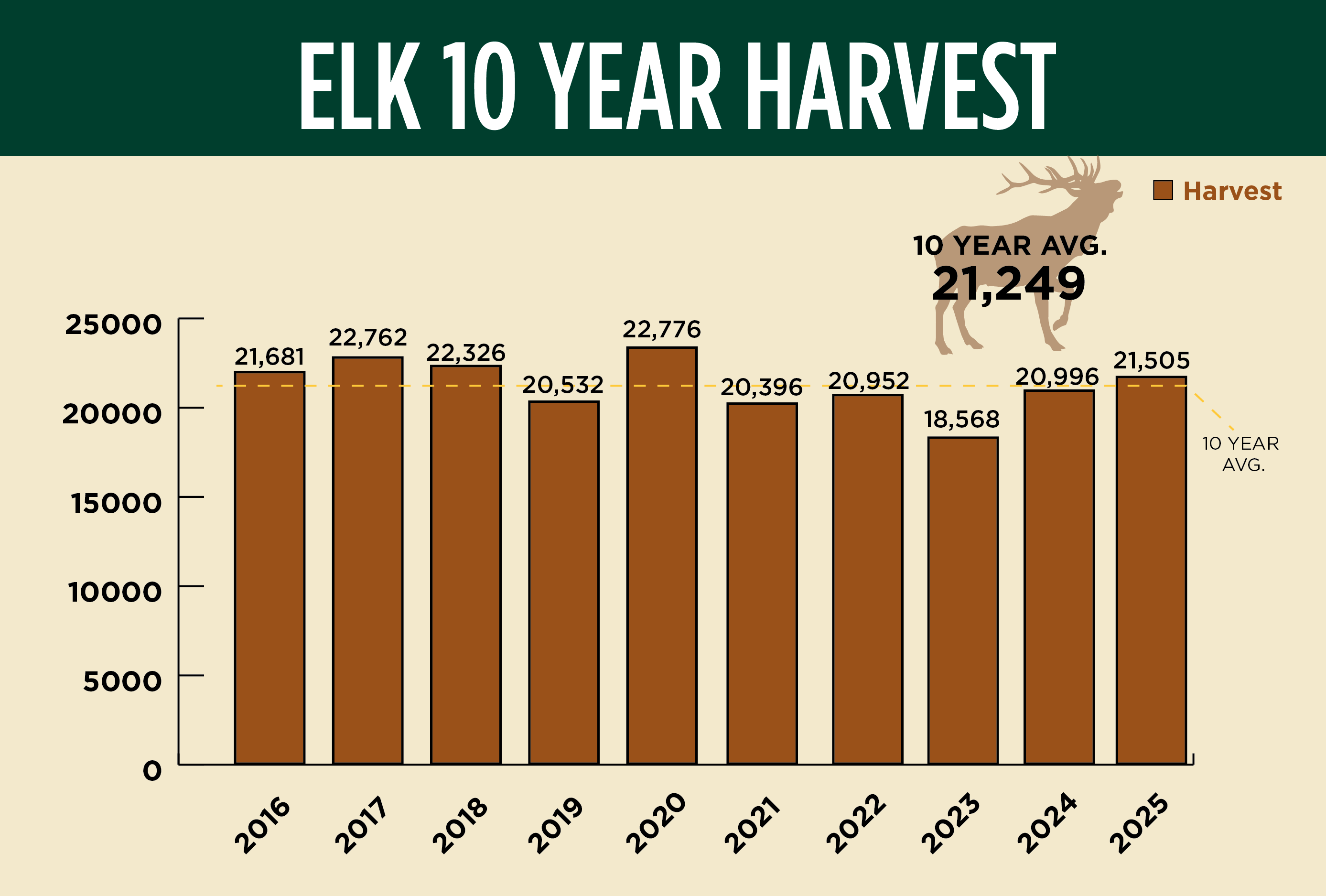
Take a look at the chart below.

elk harvest 10-year harvest

There isn’t a whole lot of fluctuation within the 10-year average (indicated by the dotted yellow line) and each year’s harvest tally, represented by the brown bar graphs. 

Fish and Game wildlife managers point out that based on hunter harvest, aerial surveys, and survival data, elk populations are doing very well—not to mention a couple of real bright spots. 

“Harvest of six-point bulls is the highest it’s been in five years,” said Fish and Game’s Deer and Elk Coordinator, Toby Boudreau. “We’re also seeing a 14% bump in total harvest since 2023.” 

Now, not to read the tea leaves and get too far out ahead of this year’s coming elk season, but this seems like a good spot to bring up that “headscratcher” of a harvest dip in the 2023 season. Afterall, elk populations were healthy and stable following that previous winter and into summer. 

That mild winter (which was a godsend following the brutal 2022-23 winter) was incredibly dry, but that summer, however, benefitted from ample precipitation, greening up elk summer range and thus keeping them fat and happy at higher-than-normal elevations. Last year’s summer did not play out that way.

Currently, as we crawl out of one of the driest, warmest winters experienced in recent decades, only time will tell if we see another similar trend in fall 2026. Successful elk hunters, believe it or not, go where the elk are. And when pitiful snowpacks and peak summer temperatures start blistering the landscape in June or even late-spring, those elk tend to go where the resources are, so keep that in mind.

We will definitely dive deeper into this year’s hunting outlook more as the season approaches and environmental conditions play out, but the reason I bring this up is to keep it in the back of your mind as you begin scouting your usual honey holes later in June and July.

MULE DEER

By the numbers

  • Total mule deer harvest in 2025: 24,588
  • 2024 harvest total: 23,898
  • Overall hunter success rate: 32%
  • Antlered: 21,539
  • Antlerless: 3,050
  • Taken during general hunts: 18,655 (28% success rate)
  • Taken during controlled hunts: 5,933 (52% success rate)

How it stacks up

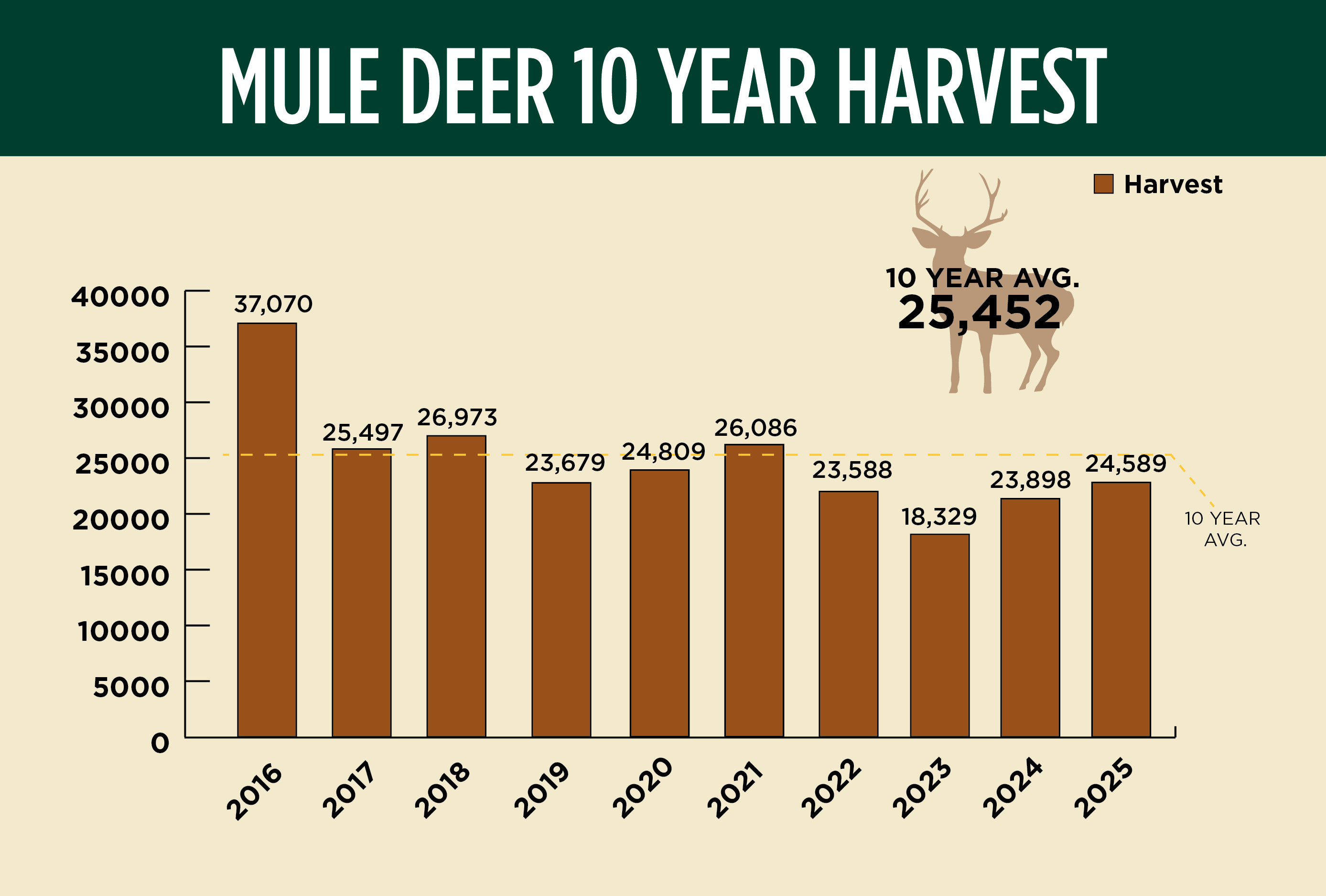
Much like elk, the 2025 mule deer harvest doesn’t really bring up any red flags. Last year’s harvest was well-within the 10-year average, which if you note the presence of the seemingly astronomical 2016 harvest in the chart below, is still hovering right below 25,452 (10-year average). 

2026 graph md 10 yr harvest

Estimated number of mule deer hunters did bump up by nearly 2,500, accounting for the same exact success percentage as last year (32%). Even general and controlled hunt success mirrored that of the previous year. 

“Last year, we saw more Idaho hunters returning to hunt mule deer,” said Boudreau. 

The big divot in mule deer harvest came in 2023, which was to be expected. By now, nearly every mule deer article written since that winter has alluded to that hit in population, specifically in regard to eastern Idaho’s deer herds, so I won’t beat that horse to death. 

The reason I bring up that year’s harvest though is to show that muley populations are rebounding, particularly in those units impacts by that brutal winter. 

As the saying goes, “hunters kill elk, winters kill deer.” And with the passing now of two utterly feeble winters, mule deer continue to rebuild their herds. But the gravy train only runs when there’s ample water and food, which hot, dry summers can negate heading into the months after.

With all that said, muley hunters can chalk up last year as a win, with increases in success rates and 4-point harvest since 2022-23. This signals that after losing a significant amount of fawns during that winter, there is a new crop of bucks that are reaching maturity. 

WHITE-TAILED DEER

By the numbers

  • Total white-tailed deer harvest in 2025: 19,702
  • 2024 harvest total: 20,908
  • Overall hunter success rate: 38%
  • Antlered: 13,302
  • Antlerless: 6,400
  • Taken during general hunts: 18,237 (37% success rate)
  • Taken during controlled hunts: 1,465 (40% success rate)

Wildlife managers anticipated a slight drop in the 2025 harvest. The culprit? The same offender that reared its head back in 2018 and 2021: EHD.

Epizootic hemorrhagic disease is the biggest harvest factor and an unfortunate reality for Idaho’s white-tailed deer. EHD occurs periodically in Idaho’s Clearwater and Panhandle regions, typically during hot summers and during drought, and sadly, that’s likely to continue in the future.

wtd 10-year harvest 2025

Fortunately, most EHD breakouts affect a relatively small percentage of the deer population—although it can have a larger effect on local herds—but the effect is typically short lived.

Last year’s EHD outbreak popped up in late July and August, paving the way for potentially another low-harvest year; however, statewide harvest held steady. 

Estimating the actual number of deer lost during an EHD outbreak is extremely difficult. However, based on the number of reports received at that time, the 2025 outbreak proved to be similar in severity to the 2021 event. 

Leading up to fall, wildlife managers chose not to alter the 2025 whitetail season. The Clearwater Region—where the bulk of the outbreak took place—had strong populations overall, and despite some localized losses, deer numbers across much of the region remained robust and well above concern.

Based on experience with past outbreaks in Idaho and neighboring states, recovery typically occurs within three to five years, depending on habitat conditions and winter survival. While EHD outbreaks can cause sudden and visible losses in localized areas, white-tailed deer populations are well adapted to recover from these events.

Fish and Game wildlife managers will continue to monitor white-tailed deer herds, particularly in those two regions, as we approach summer. But statewide, whitetails are doing well in much of the state, including five-points, which are still holding steady over 20%—a solid sign that mature bucks are still making up a good portion of the population. 

Mule deer

A note on Unit 73A’s muzzleloader and archery-only season

While this is a statewide harvest recap, it is worth mentioning Unit 73A’s inaugural muzzleloader and archery-only general season mule deer hunt and how it played out.

Following recommendations developed by an advisory committee working group composed of Idaho hunters and Fish and Game wildlife managers, the Idaho Fish and Game Commission adopted new seasons in Unit 73A that changed the any-weapon general season to muzzleloader and archery-only for the 2025 season.

As expected, both hunter participation and success rates in 2025 decreased markedly. Wildlife managers are using GPS collared mule deer, aerial surveys, and hunter information to closely monitor how this weapon-type change to the general season influences the mule deer buck population as well as the behaviors and experiences of hunters. 

Wildlife managers estimate that buck populations will be higher heading into the 2026 hunt. Fish and Game staff in the Southeast Region will have more information in the coming weeks regarding the Unit 73A mule deer hunt change and what it may look like heading into this fall.

Hunters: You make these kinds of insights possible

This might shock a few people, but knowing how many deer and elk get harvested by hunters every year depends on, well, hunters

Your involvement gives wildlife managers important hunt and harvest information that directly goes into gauging herd health across the state, figuring out where and how much hunting pressure takes place, and ultimately setting seasons and rules for the future hunting seasons.

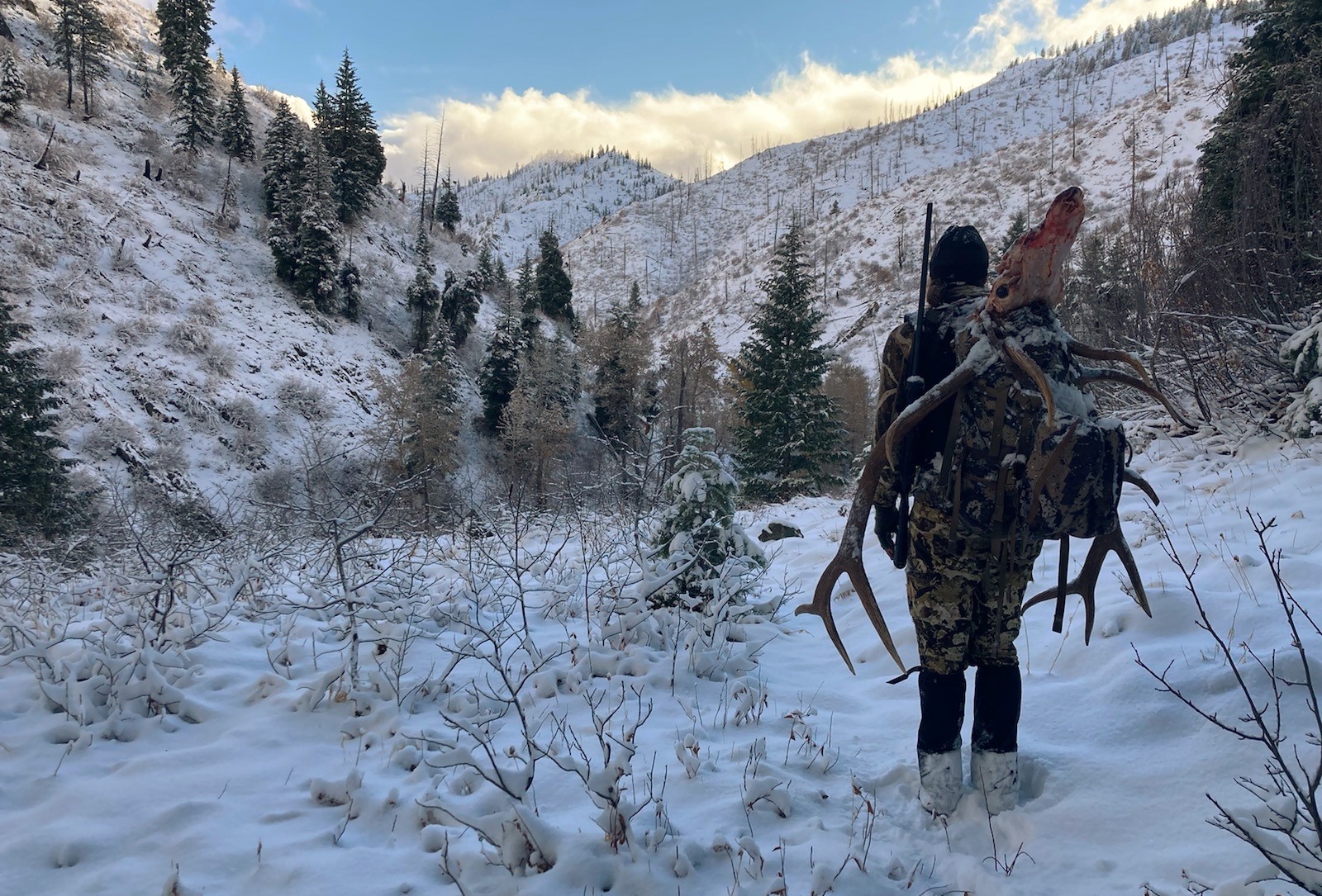
Hunter packing out skinned out elk head in the snow 2022

This is conservation at its core, folks. Nobody’s asking you for GPS coordinates or bullet weight or what flavor Mountain House you packed. It’s “Did you harvest—yes or no?” 

Hunters, take pride in knowing you’re doing your part to ensure game populations remain healthy and resilient and ensuring each species will still be there to hunt for your kids, the next generations.

Now, the moment has already come and gone to fill out hunter reports for last fall, but this is a reminder that better information means better management, which in turn can mean more hunting opportunity because a lack of good data can mean shorter hunting seasons and/or fewer tags.

I know it still feels like a century between now and the fall 2026 hunting season, but take this simple reminder and file it away. Make it a tradition every year. Do whatever you think it will take to remind yourself to fill out your mandatory hunter report after next fall’s hunt.

It’s your big game herds, so take pride in how they’re managed and conserved.