idfg-badge

Idaho Fish and Game

cassiacrossbill_sign

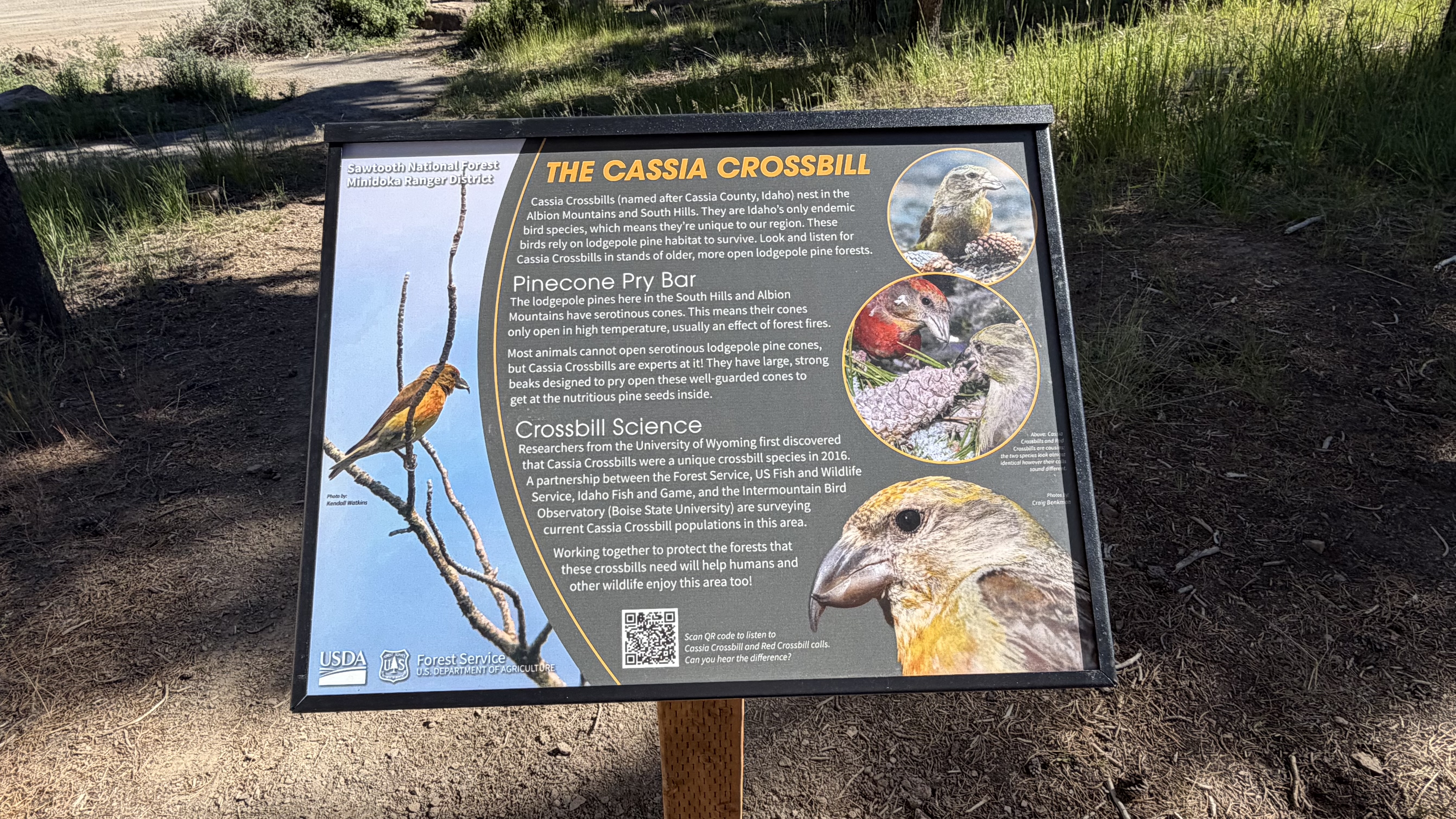
Cassia Crossbill Interpretive Sign unveiled at Diamondfield Jack Campground in the South Hills

idfg-Kenzie.Baratti

Visitors to the South Hills can now learn more about one of Idaho's most unique bird species through a new interpretive sign installed at Diamondfield Jack Campground.

The sign is the result of a collaborative effort between the Idaho Department of Fish and Game, U.S. Forest Service, U.S. Fish and Wildlife Service, Idaho Bird Observatory, Boise State University, and retired University of Wyoming professor Craig Benkman. Over the last two years, the group has worked together as part of the Cassia Crossbill Working Group to develop a habitat management plan and increase public awareness of the species and its habitat in the South Hills and Albion Mountains.

The new interpretive panel highlights the Cassia Crossbill, the only bird species found exclusively in Idaho. Cassia Crossbills rely almost entirely on the seeds found within lodgepole pinecones. Their uniquely crossed bills allow them to pry open cones and access seeds that other birds cannot easily reach.
cassiacrossbill_sign

While lodgepole pine forests are common throughout the Rocky Mountains, the Cassia Crossbill is found only in southern Idaho's South Hills and Albion Mountains. Unlike other lodgepole pine forests, these mountains lack red squirrels, which are the primary competitors for lodgepole pine seeds in most areas. This unique ecological relationship allowed the Cassia Crossbill to evolve into a distinct species found nowhere else in the world.

"Sharing information with the public about Idaho's unique wildlife helps people understand the importance of conserving the habitats these species depend on," said Lyn Snoddy, Idaho Fish and Game Wildlife Diversity Biologist. "This interpretive panel highlights the special connection between the South Hills landscape and the wildlife that call it home."

The interpretive sign provides visitors with an opportunity to learn about the Cassia Crossbill while exploring the area where the species lives. The panel also highlights ongoing conservation efforts and the importance of maintaining healthy lodgepole pine forests for future generations.

The Cassia Crossbill Working Group continues to collaborate on research, habitat management, and public education efforts aimed at conserving this unique Idaho species and the landscape it depends on.