idfg-badge

Idaho Fish and Game

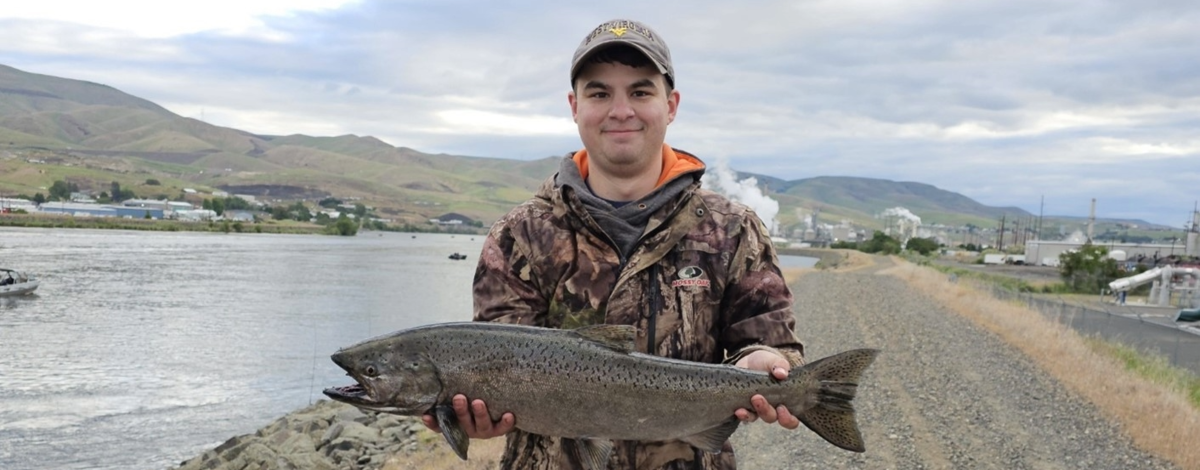
An angler stands along the Clearwater River with a Chinook salmon

Spring Chinook Fishery Update (5/19/2026)

idfg-jthiessen

Clearwater, Rapid River, and Hells Canyon

Greetings Folks,

Cumulative adult Chinook counts at Bonneville Dam (see below) are beginning to taper off and flatten out. Daily passage continues to decline, and PIT tag data indicate the run is nearing completion. Test gillnetting below Bonneville is also producing little catch, which suggests the odds of a late pulse of fish are becoming increasingly unlikely.

Downriver fisheries are reporting low catch rates, and most are expected to close or be reduced in the coming days.
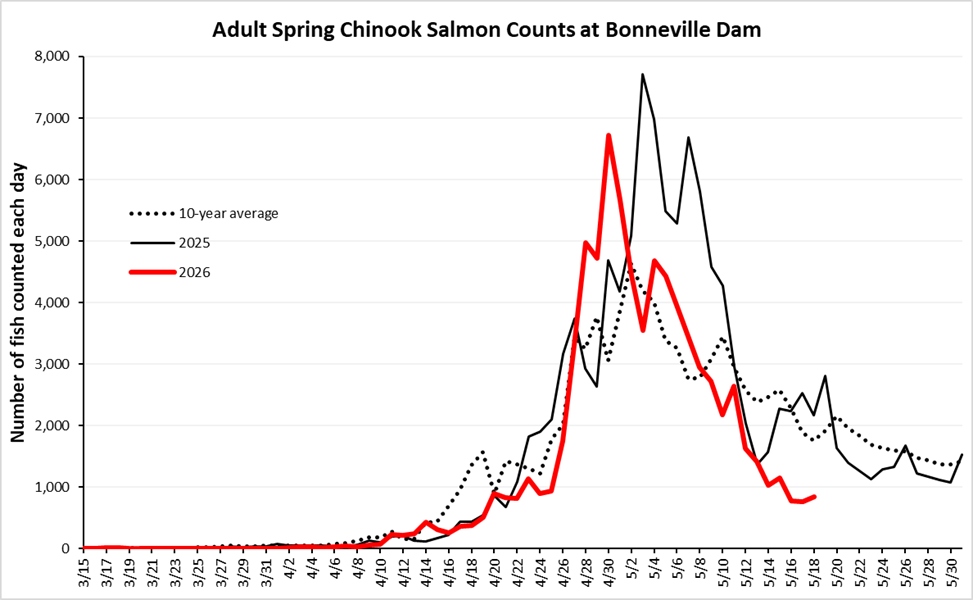
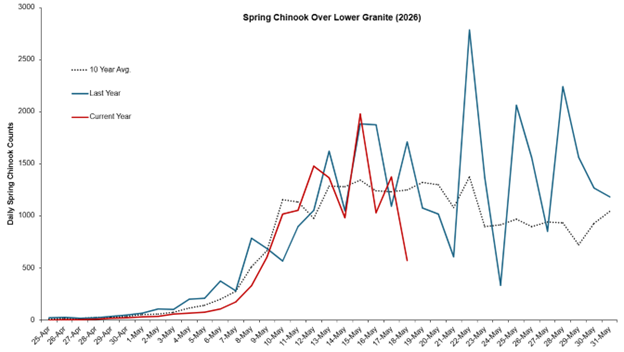
Chart: Adult spring Chinook salmon counts at Bonneville Dam

Daily counts at Lower Granite Dam (see below) indicate the peak of the run aligned almost perfectly with the Lower Clearwater fishery, though passage numbers have declined sharply over the past several days. Unfortunately, the rapid drop in fish crossing Lower Granite further reinforces the reality of this year’s underwhelming salmon return.

Chart: Spring Chinook over lower Granite (2026)

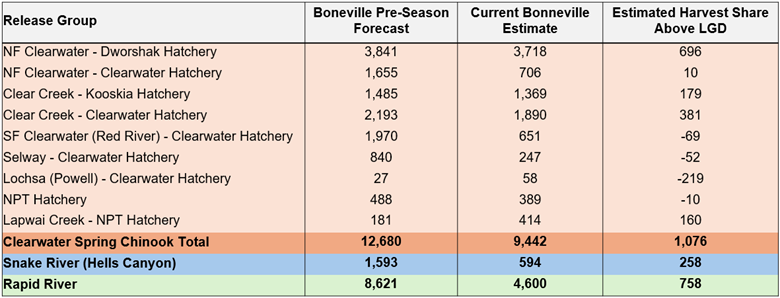
As mentioned in last week’s update, declining fish passage was expected to result in reduced harvest shares. Harvest shares are calculated using PIT tag representation to estimate the total number of returning adults for each release group (see below), with hatchery broodstock needs subtracted from the available fish.

Table of season forecasts

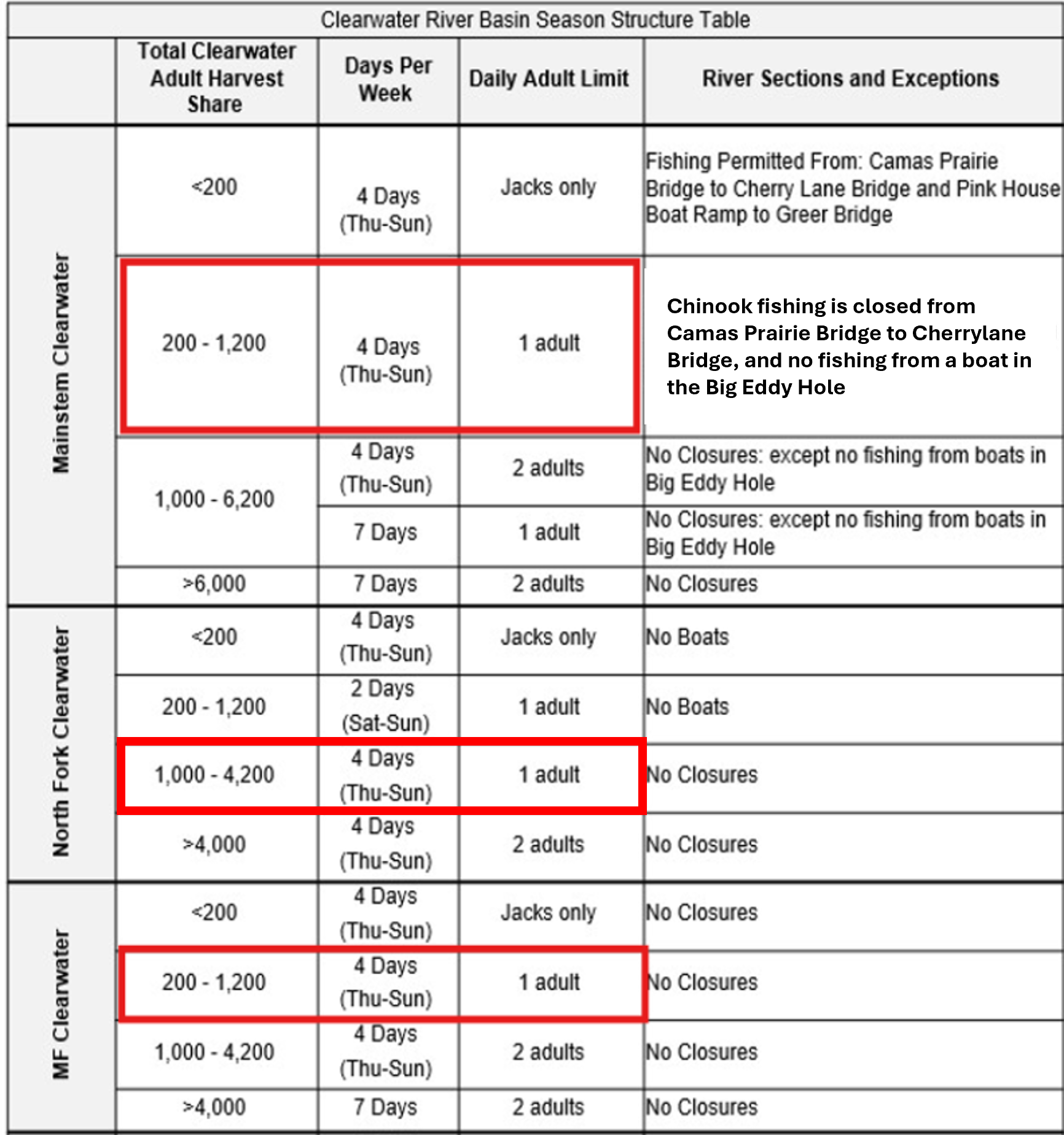
Declining Bonneville run estimates have resulted in additional reductions to harvest shares. The current harvest share for the Clearwater Basin is now 1,076 adults, which places the fishery into the next tier of the management decision matrix (see below).

Based on the matrix, the Mainstem and Middle Fork Clearwater River fisheries will continue under a 4-day (Thursday–Sunday) schedule with a 1-adult daily limit. With passage counts continuing to decline, harvest shares are expected to decrease further, reinforcing the need to reduce daily bag limits to one adult fish.

Clearwater River Basin Season Structure Table

CLEARWATER FISHERY UPDATE

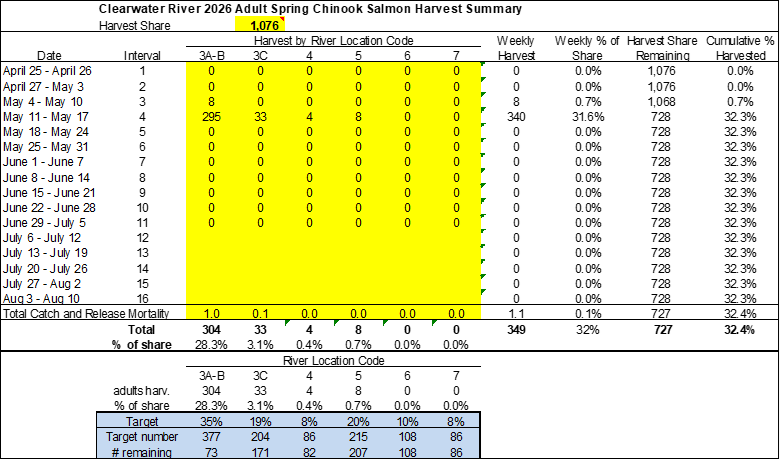
As expected, angler success improved in the lower Clearwater River over the weekend, with anglers harvesting 304 adult Chinook Salmon between the railroad bridge and Cherrylane Bridge. The harvest table and corresponding river codes are provided below.

In total, anglers harvested 32% of the available Clearwater Basin harvest share during the reporting period.

Clearwater River 2026 Adult Spring Chinook Salmon Harvest Summary

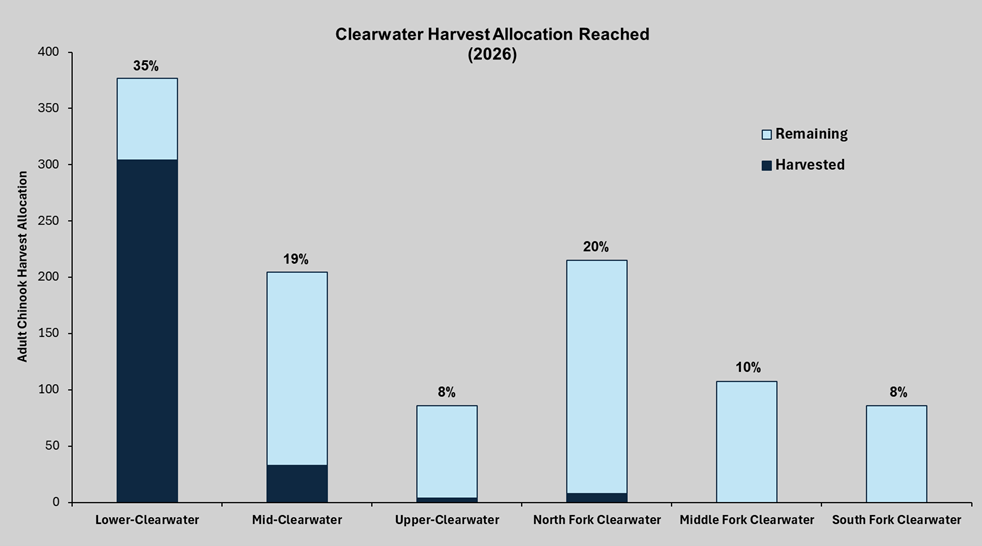
The figure below illustrates harvest allocation by river section. Dark blue bars represent the number of fish harvested, while light blue bars represent the remaining unharvested allocation. The percentage shown above each bar indicates that section’s proportion of the total basin-wide harvest share.

As shown, most of the harvest is occurring in the lower Clearwater River. Currently, the lower Clearwater section is just 78 fish short of reaching its allocation target of 35% of the basin-wide harvest share.

At current catch rates, the lower Clearwater River fishery can harvest more fish in a single day than what remains available within that section’s allocation. Because of this, the lower Clearwater River will close to Chinook fishing effective Thursday, May 21.

Clearwater Harvest Allocation Reached (2026)

Before people jump to conclusions, it is important to understand the actual numbers behind these decisions. The 2-fish daily limit accounted for 43 additional Chinook harvested in the Clearwater Basin that likely would not have been harvested under a 1-adult daily limit. Even if those fish were added back into the remaining harvest share, the lower Clearwater section still would not have enough allocation remaining to stay open through another 4-day interval.

Likewise, harvest patterns from previous seasons suggest that even under a 7-day, 1-adult fishery structure, the lower Clearwater would still not have enough allocation remaining to continue fishing this week. Given this year’s run size and harvest share, all realistic management scenarios ultimately lead to the same outcome: closure of the lower Clearwater section this week.

In short, the 2-fish opener increased angling opportunity without reducing the overall duration of the fishery. Harvest in the lower Clearwater currently represents 28% of the basin-wide harvest share, compared to a management objective of 35%. While still short of the target, that is an improvement over both last season and the recent five-year average of 25%.

RAPID RIVER AND HELLS CANYON UPDATE

The first harvested fish from both returns were documented over the weekend. As more fish arrive, catch rates should improve. However, harvest shares continue to decline. The Rapid River harvest share has now dropped to 758 adults. Anglers should expect both the Lower Salmon and Little Salmon fisheries are projected to reach harvest shares quickly. 

The only remaining possibility for a modest increase in harvest share is from genetic sampling data collected at Lower Granite Dam. In some years, PIT tag data underrepresents the true number of hatchery fish returning. Even if that occurs this year, expectations should remain modest, because there simply are not many fish returning.

TAKEAWAY

I know this is a frustrating year for anglers, but this is exactly why active fishery management exists. The objectives are to meet broodstock needs, achieve harvest share, distribute opportunity throughout the basin, and maximize fishing duration. During low-return years, some of those objectives become much more difficult to achieve simultaneously.

The goal remains to maximize opportunity, duration, and distribution in a fair and equitable manner. That becomes increasingly challenging when managers are tasked with allocating a shrinking resource in real time. This years season structure maximized the likelihood of achieving set fisheries objectives.