idfg-badge

Idaho Fish and Game

Smallmouth bass from Dworshak Reservoir

Dworshak Reservoir Kokanee and Smallmouth Bass Update

idfg-tzumwalt

2024 updates on Kokanee and Smallmouth Bass in Dworshak Reservoir

Kokanee

Last year was a great year for kokanee anglers. Age-2 and 3 kokanee are the age classes that grow large enough to catch (≥ 8 inches), and both were more abundant than the 20-year average in 2024 (Figure 1). These fish also averaged 10 to 11 inches, which matches the 20-year average. As a result, the 2024 fishing season provided great kokanee angling opportunities. 
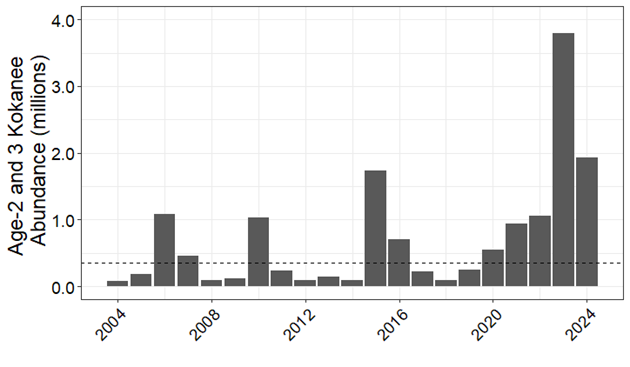
Age-2 and 3 kokanee abundance in Dworshak Reservoir
Figure 1. Estimated abundance of age-2 and 3 kokanee on Dworshak Reservoir from 2004 – 2024. The dotted line represents the 20-year average abundance.

One interesting anecdote observed from 2024 sampling by Idaho Department of Fish & Game (IDFG) staff was an above-average abundance of age-3 kokanee for the second consecutive year. Historically in Dworshak, most age-2 kokanee spawn and die in the fall, making age-3 kokanee a rare occurrence. Occasionally however, age-2 kokanee will experience slow enough growth to average out at 8 inches, resulting in a portion that will wait until the next year to spawn. In 2022 and 2023, this phenomenon happened, resulting in an above-average abundance of age-3 fish.

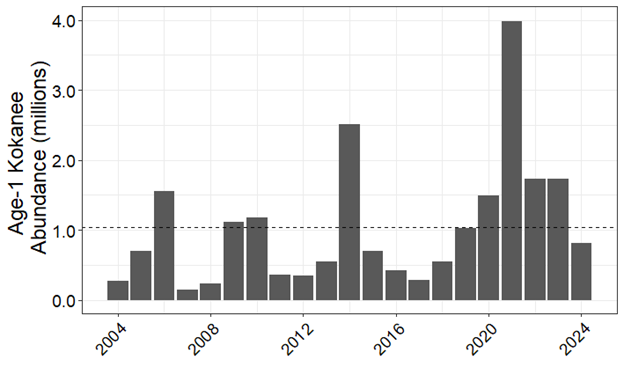
For 2025, we expect fewer age-2 and 3 kokanee than what occurred in 2023 and 2024, but we expect them to be larger. Surveys in 2024 showed a below-average age-1 abundance (Figure 2), meaning there will likely be a below-average abundance of age-2 kokanee this year. Additionally, we expect fewer age-3 kokanee this year because most age-2 kokanee likely spawned last year due to their 10-inch average size. The good news however, is that with a lower abundance there will be less competition for food, resulting in high growth potential for these age classes. Historically in these types of conditions, age-2 kokanee reached lengths of 11-12 inches and anglers are already reporting catches at this size in 2025, with a few exceeding 13 inches.

Age-1 kokanee abundance in Dworshak Reservoir
Figure 2. Estimated abundance of age-1 kokanee on Dworshak Reservoir from 2004 – 2024. The dotted line represents the 20-year average abundance.

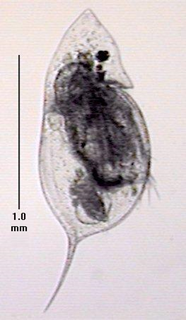
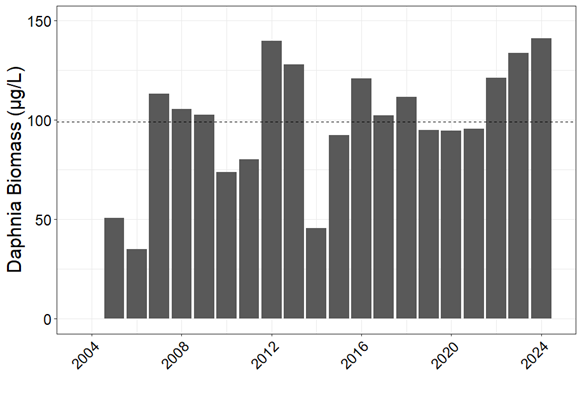
Zooplankton are the essential food source for kokanee in Dworshak Reservoir (Figure 3). IDFG surveys have also shown zooplankton biomass has increased the last few years, despite high abundances of kokanee (Figure 4). This can be attributed to the success of the nutrient restoration program in the Reservoir. The nutrient restoration program has increased zooplankton biomass and growth potential of kokanee, which in turn has contributed to the larger and more abundant fish seen in Dworshak this year.

Daphnia
Figure 3. Photo of Daphnia zooplankton, a primary food source for Dworshak kokanee.
Abundance of daphnia in Dworshak Reservoir
Figure 4. Estimated biomass of Daphnia zooplankton on Dworshak Reservoir from 2004 – 2024. The dotted line represents the 20-year average biomass.

Smallmouth Bass

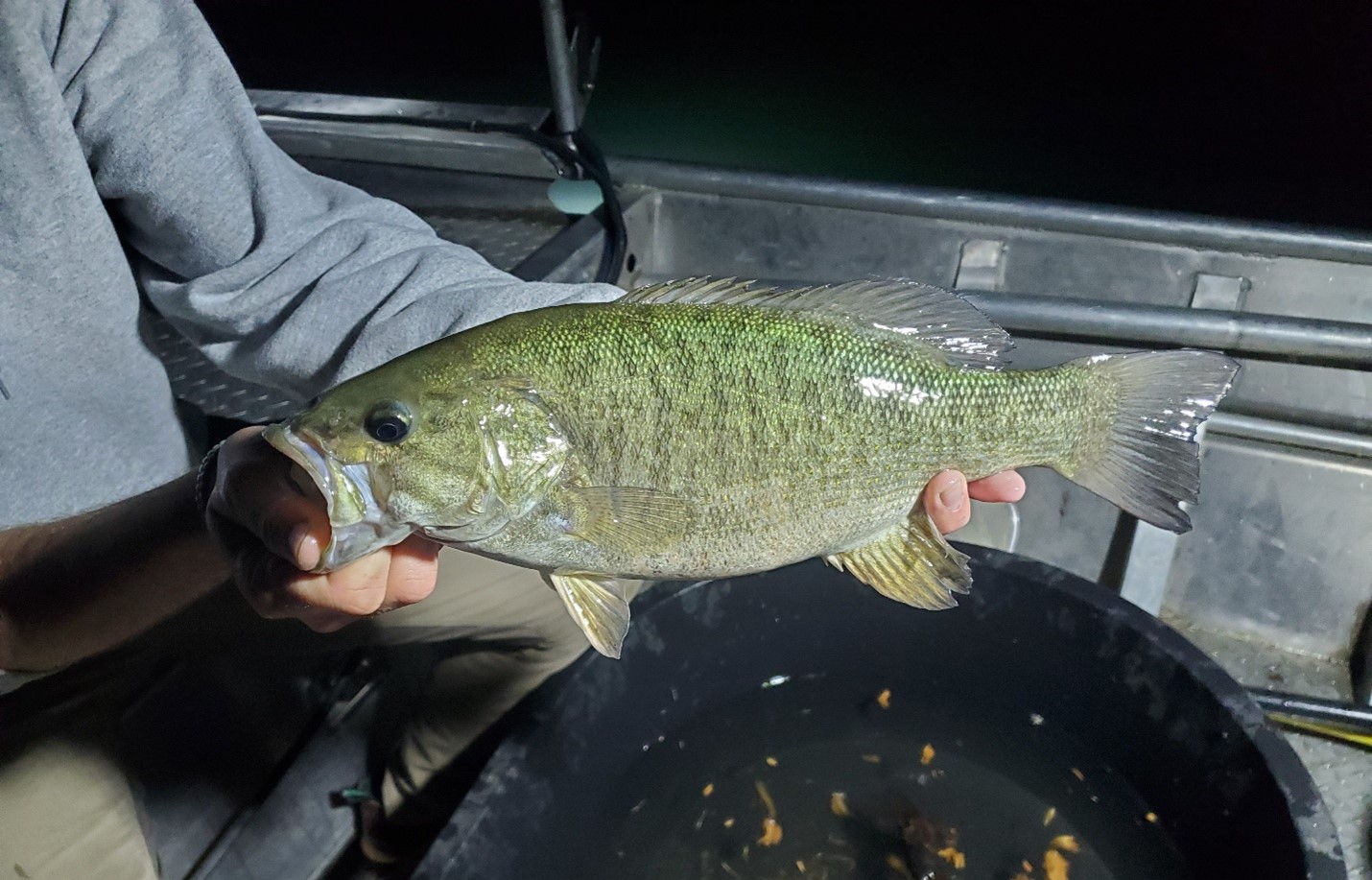
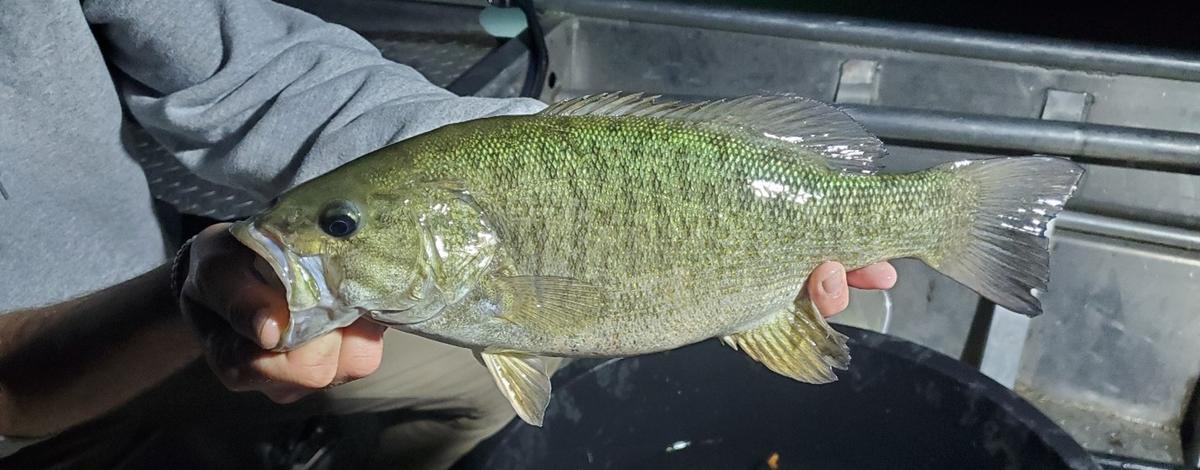
Electrofishing surveys in 2024 found more juvenile Smallmouth Bass (ages 0 - 4 fish up to 8 inches) in Dworshak Reservoir compared to the last few years. This is a good indication that conditions have been favorable for spawning success and/or juvenile survival. More juveniles also indicates there will likely be more mature fish available in the coming years. Research by IDFG also shows the growth of bass older than age-6 in Dworshak is dependent on kokanee abundance. If kokanee abundance continues to cycle at the levels it has in the last five years, we expect growth will remain high for Smallmouth and continue to provide fish that reach trophy sizes (≥ 20 inches and/or ≥ 4 lbs) (Figure 5).

Smallmouth bass from Dworshak Reservoir
Figure 5. Smallmouth Bass captured from 2024 electrofishing conducted by IDFG staff.

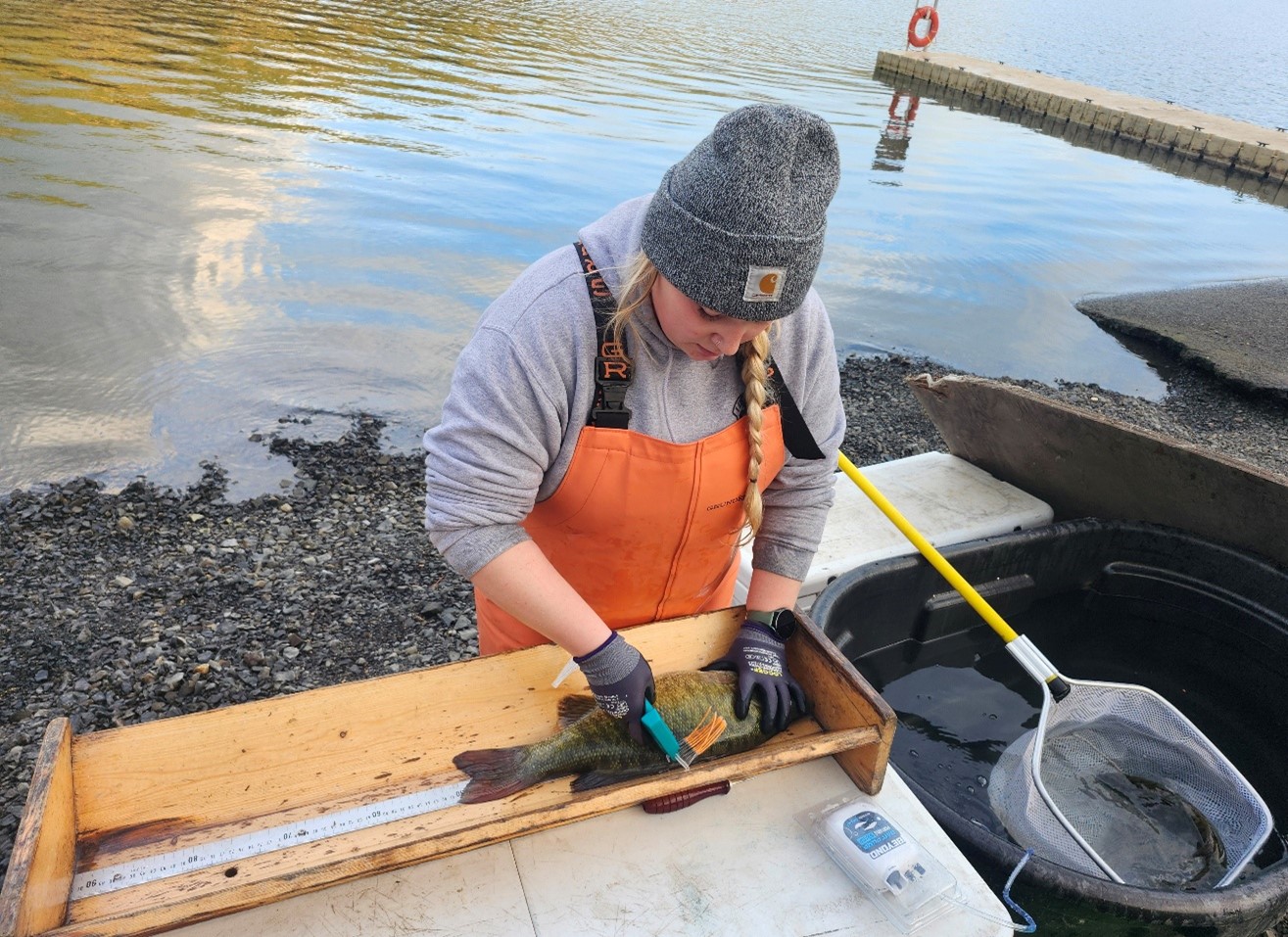
IDFG has been tagging adult Smallmouth Bass (>10 inches) with T-bar anchor tags (Figure 6) to understand how often these fish are caught and harvested and how abundant they are. These efforts have found that even with an increase in the number of tournaments in 2024, few (24%) tagged adult Smallmouth Bass were recaptured and even fewer (7%) were harvested. Additionally, this data indicates there are plenty of adults in the reservoir and plenty available to anglers in 2025. 

Figure 6. T-bar tagging Smallmouth Bass during a tournament on Dworshak Reservoir
Figure 6. T-bar tagging Smallmouth Bass during a tournament on Dworshak Reservoir.

The relationship between kokanee and Smallmouth Bass in Dworshak is important for anglers to understand. Specifically, it’s important for anglers to recognize what an average vs high abundance of juvenile kokanee means for Smallmouth fishing. In 2021-22, the record high abundances of juvenile kokanee resulted in incredible growth rates of Smallmouth Bass and phenomenal angling for trophy Smallmouth Bass, even leading to the Idaho state catch-and-release record being broken. With the cyclical nature of kokanee abundance, the unfortunate reality is that exceptional Smallmouth Bass growth, as experienced in 2021 and 2022, is not something that occurs regularly in Dworshak Reservoir. Over the last twenty years, kokanee abundance has only been high enough three times to provide these types of growth rates. So while 2025 Smallmouth growth may not mirror that of 2021-2022, the abundance of kokanee in the reservoir should still provide growth rates high enough to support trophy-sized Smallmouth.

IDFG has also initiated the Dworshak Angler Science Program in 2025. Similar to what was implemented on Lake Pend Oreille and the Kootenai River, the Dworshak Angler Science Program is a way for anglers to help IDFG better understand and manage the Smallmouth population and obtain cool gear while doing so. The program aims to have anglers assist with tagging Smallmouth Bass with T-bar anchor tags that help to characterize the population.

Having assistance with these tagging efforts ensures that enough tags are deployed to accurately estimate abundance, survival, and harvest.  These efforts also help ensure that Smallmouth fishing on Dworshak will remain the best in the state for future years. 

Dworshak Reservoir Angler Science Program logo
Figure 7. 2025 logo for the Dworshak Angler Science Program.

Currently, the Dworshak Angler Science Program has a small group of experienced anglers that have been very helpful and effective at deploying tags in Smallmouth Bass. IDFG biologists are in the process of training more anglers on proper tagging techniques and data collection. To show their appreciation, IDFG will be handing out gear (t-shirts, sweatshirts, hats, water bottles, etc.) sporting the Angler Science Program logo (Figure 7).  While the program is still in its infancy, it has already saved valuable time and resources thanks to passionate anglers willing to help.