idfg-badge

Idaho Fish and Game

chinook

Clearwater Region Spring Chinook Update 6/2/2026

idfg-jthiessen

What an ominous and challenging spring Chinook season this has been. Unfortunately, that trend will continue, as the Clearwater, Lower Salmon, and Hells Canyon fisheries are close to Chinook fishing moving forward (see official closure order HERE).

The Little Salmon River will remain open Saturday and Sunday with a 1-adult daily limit, as 140 fish remain within the Rapid River harvest share.
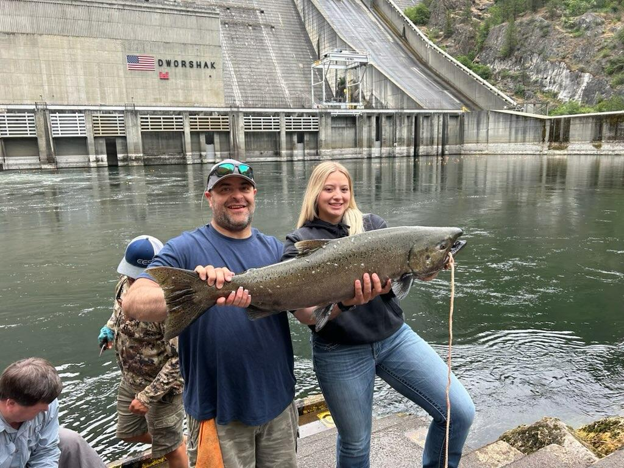
Chinook Dworshak

Spring Chinook Run Summary

Many folks have called, emailed, texted, or stopped by the office asking the same question: “What happened this season?” I will do my best to summarize the moving parts that shaped this year’s fishery.

Preseason forecasts are generated largely using jack return information from previous brood years. Broodstock needs are first subtracted from the forecasted return, and the remaining fish are then divided evenly between the sport and tribal harvest shares. For 2026, the preseason sport harvest share was projected at 2,009 adults for the Clearwater Basin and 1,923 adults for the Rapid River return. While these were considered moderate harvest shares, recent years had exceeded preseason forecasts, so fish managers entered the season optimistic about the opportunity this run could provide.

As Chinook move upstream through the Columbia River system, managers closely monitor conversion rates between dams. On average, 75% of Idaho-bound fish passing Bonneville Dam successfully reach Ice Harbor Dam. Once fish pass Ice Harbor Dam, managers typically expect about 95% of those fish to successfully pass Lower Granite Dam. Because of this historically high conversion rate, lower Snake River fisheries have generally had relatively limited impacts on Idaho fisheries, as managers collaboratively account for the small percentage of expected catch. Collectively, 74% of Idaho-bound fish counted at Bonneville Dam ultimately return to Idaho fisheries upstream of Lower Granite Dam.

Once fish pass Lower Granite Dam, Idaho fisheries are already underway, and managers begin refining harvest shares using the actual run size observed at Lower Granite rather than relying solely on preseason forecasts. Depending on the run strength, this can either increase or decrease the available harvest share during the season. IDFG also collects genetic samples at Lower Granite Dam to verify stock composition and ensure PIT tag data accurately reflects the proportion of each returning stock, including Clearwater, Rapid River, upper Salmon, and others.

What occurred this season has not been documented in the roughly 30 years IDFG has managed these fisheries under the current framework. Conversion rates between Ice Harbor Dam and Lower Granite Dam declined dramatically, dropping from the expected 95% to approximately 87%. That reduction substantially decreased the number of fish ultimately reaching Lower Granite Dam and, in turn, significantly reduced the available harvest share upstream in Idaho.

At face value, an 8% decline in conversion may not sound substantial. However, when applied to an already modest run size, relatively small percentage changes can have major impacts on available fishing opportunity and harvest allocation.

Early public concern understandably focused on whether lower Snake River fisheries exceeded their harvest shares. However, harvest accounting provided by individual fisheries managers did not fully explain the deficit observed at Lower Granite Dam. Other theories focused on spill operations and water management, though operational adjustments made during the migration period did not appear to improve conversion rates.

At this point, all co-managers are actively working together to better understand what occurred during this migration, identify where losses may have occurred, and determine what management or operational adjustments may help prevent similar issues in the future.

This season was frustrating for everyone involved; anglers, guides, tribes, and fisheries managers alike. Despite the difficult outcome, I appreciate everyone who participated in the fishery, provided feedback, and remained engaged throughout a very challenging season.

Clearwater Chinook Fisheries:

Based on the initial Chinook return over Bonneville Dam and early-season conversion rates, the Clearwater Basin entered the season with an estimated sport harvest share of 1,202 adults. Early indications suggested the run would stabilize and sustain that harvest share, so IDFG managers structured fisheries to meet those harvest objectives.

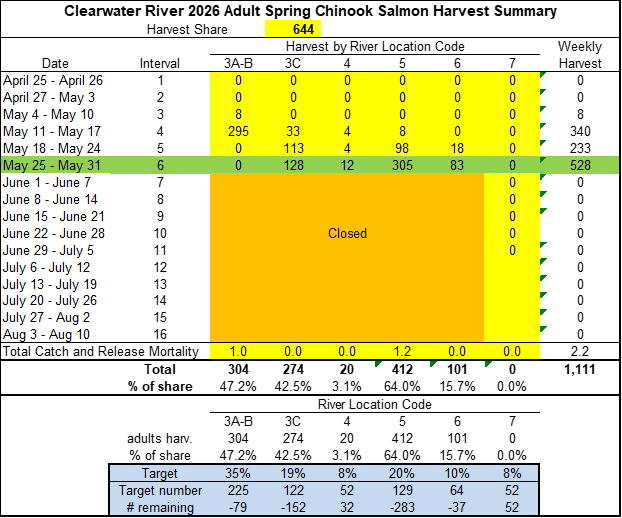
Harvest started relatively slow as fish first entered Idaho waters (see Clearwater harvest table below), but effort and success increased substantially during the fourth week of the season in the lower Clearwater River. That uptick in harvest, combined with a declining harvest share, resulted in the closure of the lower Clearwater fishery. The remainder of the Clearwater Basin stayed open four days per week with a 1-adult daily limit, at which time approximately 727 fish remained within the harvest share.

Clearwater harvest

During the following fishing interval, harvest increased again in the mid-Clearwater River above Cherrylane Bridge and in the North Fork Clearwater River, with anglers harvesting 233 adult’s basin-wide. At that point, approximately 388 fish remained within a reduced harvest share of 970 adults. Fisheries managers subsequently recommended leaving the season open for an additional interval, anticipating only minimal reductions to the harvest share.

Unfortunately, conversion rates to Lower Granite Dam continued to deteriorate. As reflected in the table above, the harvest share declined sharply while harvest in the North Fork Clearwater River accelerated significantly. By the end of the season, the final sport harvest share dropped to its current value of 644 adults, while anglers harvested an estimated 1,111 adults basin wide.

If there is a silver lining in all of this, there are probably two:

  1. Anglers received substantially more fishing opportunities on a run of this size than they traditionally would have.
  2. IDFG structured fisheries around the best available information at the time, targeting a 1,202-fish harvest share, and harvest tracked remarkably close to that objective until conversion rates unexpectedly collapsed.

Had conversion rates remained near historical averages, managers likely would have been discussing closure of most Clearwater fisheries this week while potentially leaving portions of the South Fork Clearwater River open briefly to harvest the remaining allocation.

Rapid River and Hells Canyon Fisheries:

The Rapid River and Hells Canyon fisheries experienced a similar fate this season, although harvest patterns differed somewhat from those observed in the Clearwater Basin. In the lower Salmon River, harvest never fully accelerated at the same time the harvest share was declining. Because Chinook require additional time to reach these fisheries after passing Lower Granite Dam, fishery structures in the Salmon Basin are typically more reflective of the actual in-season run size rather than operating heavily off preseason forecast projections alone.

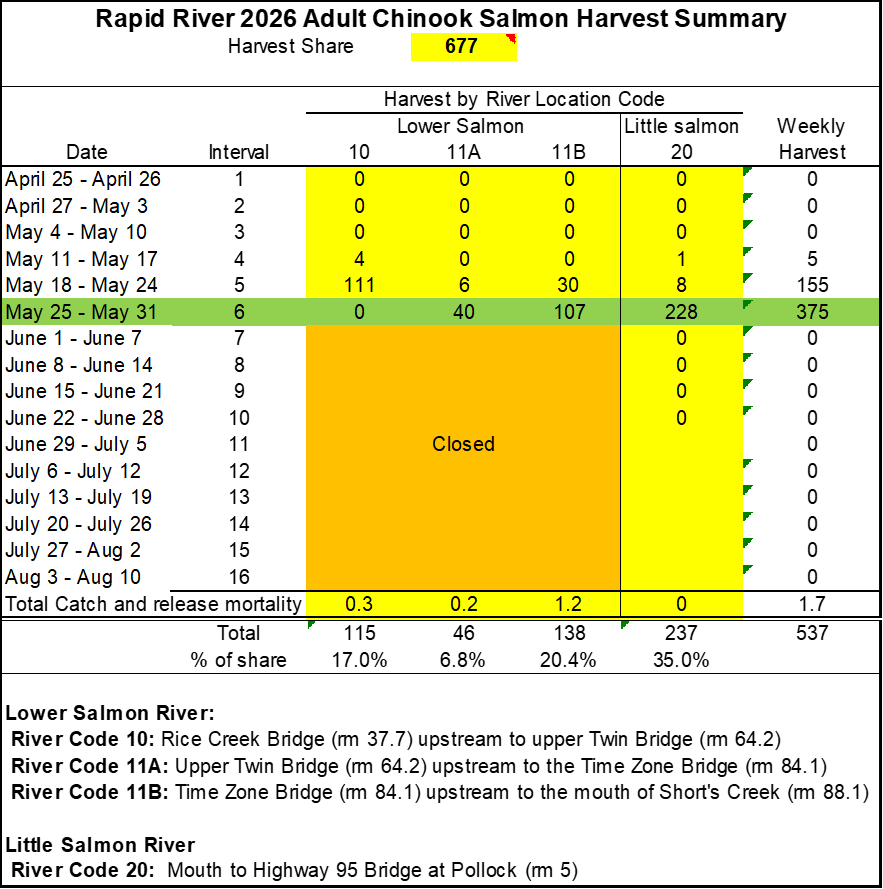
Even so, the Rapid River harvest share still declined substantially throughout the season, dropping from a preseason projection of 1,923 adults to a current estimate of 677 adult Chinook salmon.

Following closure of the lower Salmon River fishery, harvest in the Riggins area (see harvest table below) increased considerably. Catch rates were moderate at best given the amount of angler effort observed, but anglers still harvested 375 adults during the most recent four-day fishing interval.

Rapid River Harvest

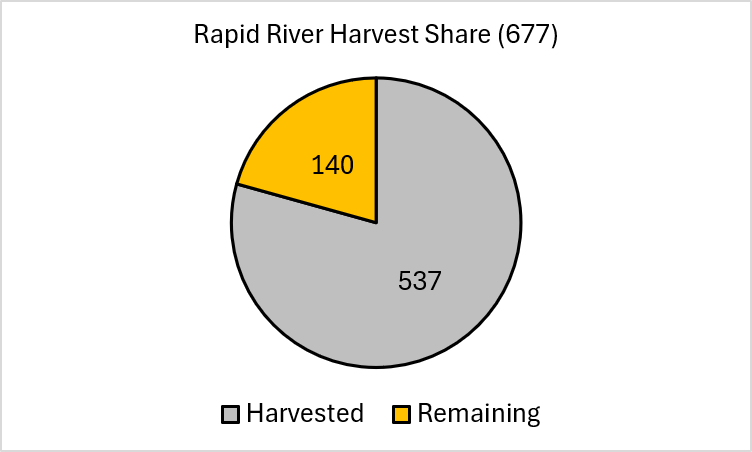
Total seasons harvest now sits at 537 adults, leaving approximately 140 fish remaining within the harvest share (see figure below). At this time, the Little Salmon River will remain open with a two-day fishery interval (Saturday and Sunday).

RR harvest share

Hells Canyon Harvest share dropped substantially from 290 to 91 currently. The total harvest currently sits at 146 adults, effectively shutting down the fishery for the season.

CLEARWATER SUMMER CHINOOK SEASONS

The Lochsa River will also remain open for summer Chinook fishing seven days per week with a 2-adult daily limit. Both adipose fin-clipped and unclipped fish may be harvested in the Lochsa. Given how the spring return developed this year, many anglers may question why the Lochsa season remains open. Historically, the Lochsa release group consisted of summer-returning Chinook salmon, though that program never produced strong or consistent returns. Moving forward, IDFG has transitioned this release group to spring-returning Chinook in hopes of improving adult returns to levels more consistent with other Clearwater spring Chinook programs.

Because the summer Chinook program is being discontinued, hatchery staff no longer require these fish for broodstock needs. As a result, anglers are encouraged to harvest the fish that do return. The current preseason forecast for the Lochsa return is 321 adult summer Chinook. However, given the poor conversion rates observed elsewhere throughout the Snake River system this spring, the actual return may ultimately fall short of that forecast. Regardless, fish are present and opportunities remain available for anglers looking to get out of town and try their luck.

Message to the Anglers

I entered this position fully aware that difficult decisions would come with the responsibility of managing Idaho’s Chinook fisheries. My goal has always been to provide the most responsible and equitable harvest opportunity possible while staying within the biological and legal constraints of the fishery.

This season has been frustrating for everyone involved, and frankly, it has been a difficult lesson for anglers, co-managers, and fisheries managers alike. I would not be doing these shared resources or the people who care deeply about them any justice if I ignored the challenges experienced this season or dismissed them as simply an anomaly. There are lessons to be learned from what occurred this spring, and I can assure you those lessons will shape how I approach future seasons and future uncertainty.

The overwhelming majority of interactions I’ve had with anglers this season have been respectful, constructive, and appreciated. Even during difficult conversations, it is clear how passionate people are about these fisheries and the opportunity they provide. For those interactions that were less constructive, I hope this season also serves as a reminder of just how complex and fragile these fisheries truly are.

As the run comes to completion, I will provide Jack returns and an outlook for next year’s fishery. Until then, please look for the upriver Chinook updates from the Little Salmon, South Fork Salmon, and Upper Salmon Managers