idfg-badge

Idaho Fish and Game

Underwater shot of kokanee spawning

Biologists working to understand what is driving a slow kokanee recovery at Deadwood Reservoir

idfg-bpearson

Deadwood Reservoir has long been the beating heart of Idaho’s early-run kokanee program. For decades, its wild kokanee provided both a popular sport fishery and millions of eggs used to seed other waters statewide, supporting fisheries from Lake Pend Oreille in the Panhandle to Ririe Reservoir in eastern Idaho.

However, the kokanee population at Deadwood has struggled recently, both in terms of numbers and average size. Biologists have been closely monitoring the fishery over the past few years, seeking answers while making adjustments to prime the kokanee population for a comeback. 

On a positive note, gillnet surveys in 2024 and 2025 showed a slight increase in kokanee numbers compared to the previous two years (although average sizes remained below objectives). Also, spawner surveys conducted this summer documented thousands of fish spawning in the upper reaches of the reservoir’s main tributary.
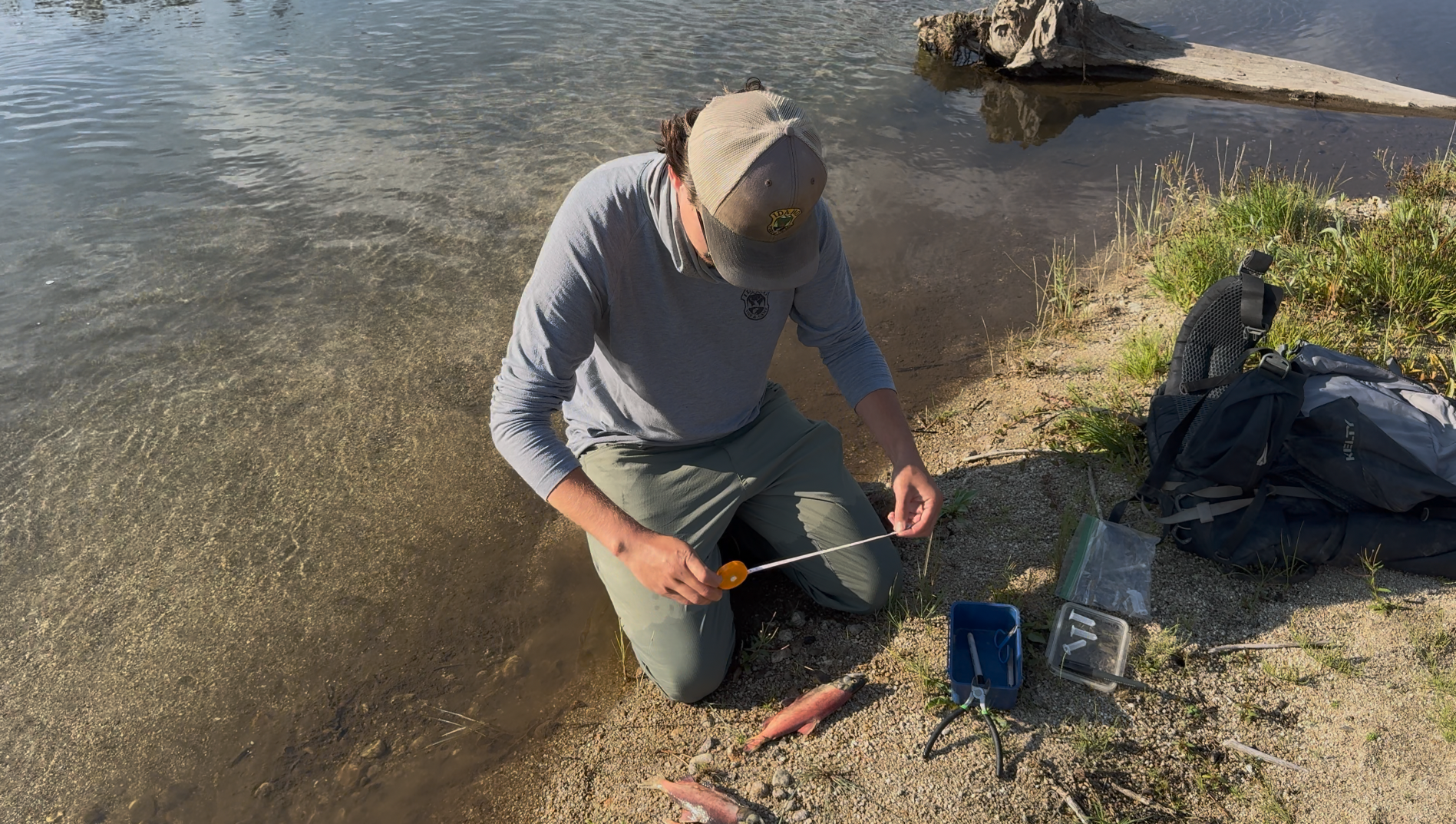
Fisheries technician Caleb Wilson measures kokanee carcasses during a 2025 spawner survey
Fisheries technician Caleb Wilson measures a kokanee carcass on the Deadwood River during a 2025 spawner survey.

All this offers hope that the kokanee population is ready to turn a corner after several years of uncertainty. But even if that occurs, Fish and Game staff won’t be satisfied because something was different about this chapter in Deadwood’s history, and managers want to know why.

“The crucial unknown is why this population has responded to low abundance differently, and more slowly, than it has historically,” said Regional Fisheries Manager Art Butts. “Finding an answer to that question could be the key to developing a sustainable management strategy for this fishery going forward.”

A weird three years at Deadwood

In 2022, record-low catch rates during an annual gillnet survey rang alarm bells for biologists after there appeared to be a fluctuating population on a declining trend.

What was particularly puzzling was that, despite biologists observing fewer kokanee, they did not see a corresponding increase in fish size. It’s well established that the classic tradeoff with kokanee is fewer, but larger kokanee, or more fish, but smaller average size. 

Despite Fish and Game effectively halting the collection of eggs to allow the population to recover, concern grew the following year. Deadwood’s kokanee population had a history of recovering quickly after a downturn, but that wasn’t happening. 

In 2023, fishery managers determined that a more in-depth evaluation was needed to understand what was slowing the recovery of the kokanee population and whether management could be changed to improve production and growth. 

Since then, fisheries biologist Tim D’Amico and his crew have examined several factors that may be influencing the change in kokanee population dynamics in Deadwood, including predation, food base limitations, and water quality.

“We’re three years into this and collecting more data than we ever have at Deadwood,” D’Amico said. “We haven’t found the smoking gun yet, but we’re still looking for answers.”

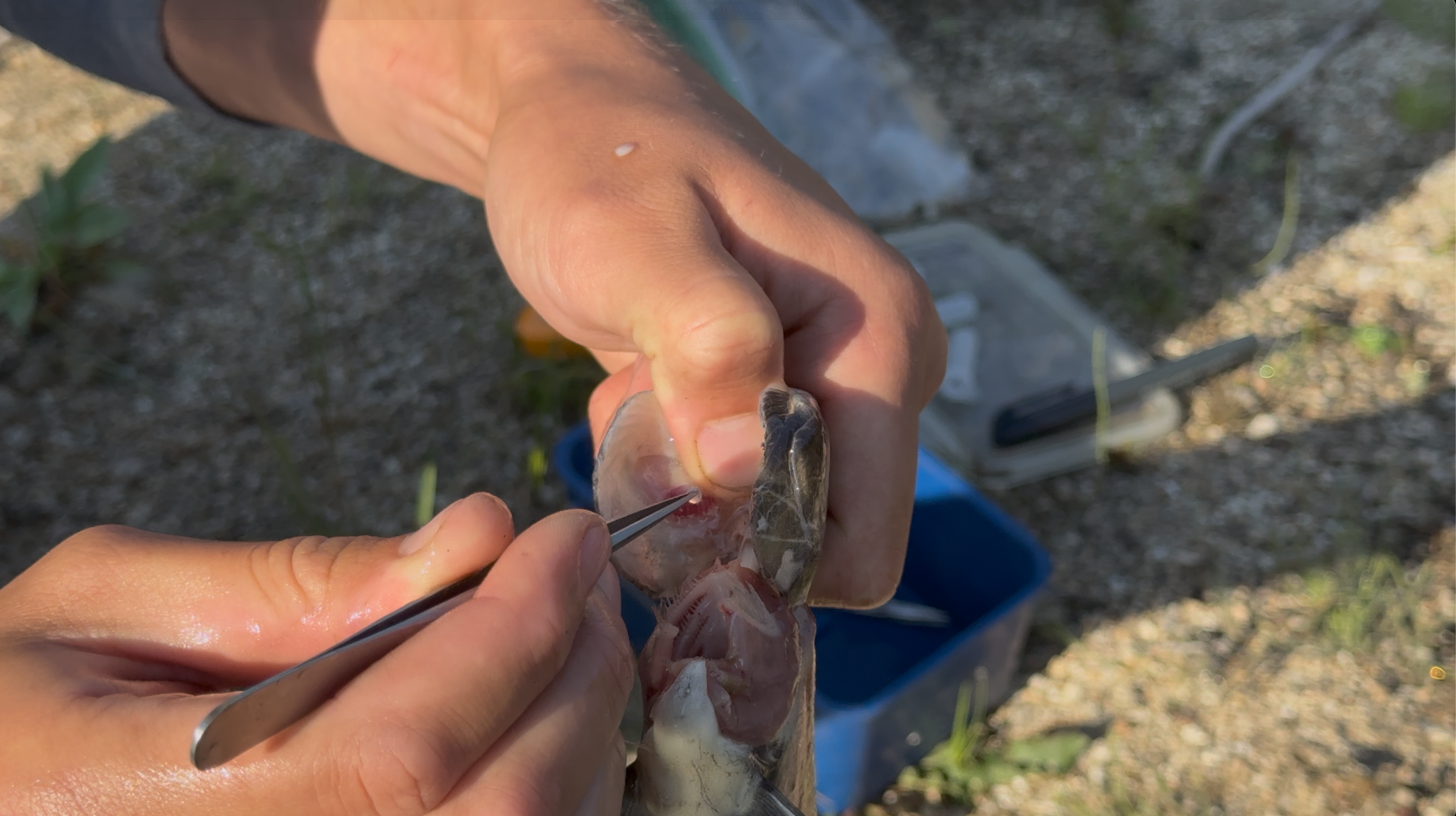
A fisheries technician removes an otolith (a hard structure in a fish's inner ear) that will be used to age and identify the origin of the fish.
A fisheries technician collects an otolith from a kokanee carcass during a 2025 spawner survey on the Deadwood River. Biologists will use the otolith to age the fish, but also to identify whether it was stocked from a hatchery or was produced naturally at Deadwood.

Crossing off suspects while searching for a smoking gun

Initially, plankton sampling in 2023 suggested that the kokanee population was limited by food availability. 

“Kokanee feed exclusively on zooplankton, and the zooplankton community looked pretty dismal when we sampled it in 2023,” D’Amico said. “When we repeated that process in 2024, the picture looked a lot less bleak—but still not great.”

In 2023 and 2024, sampling at Deadwood also included kokanee gillnets, predator gillnets, and water chemistry analysis. Fisheries staff examined the stomach contents of rainbow trout and landlocked Chinook salmon and did not observe much kokanee predation.

“While there’s undoubtedly some kokanee predation in Deadwood, we can say with confidence that it’s not the driving factor,” D’Amico said.

Water chemistry samples were submitted to two different laboratories for analysis. The takeaway from both labs was that Deadwood was a very sterile waterbody, which wasn’t surprising: Most of the upper Payette River watershed has low nitrogen and phosphorus levels. These nutrients form the basic building blocks of the food web.  

For both water chemistry and zooplankton, what biologists were missing was context. 

“We just don’t have quality data over a long period of time to know what ‘normal’ looks like for Deadwood,” D’Amico said.

This year, biologists are continuing to collect water chemistry and zooplankton samples from Deadwood Reservoir. Over time, the data they collect will help provide some of that context.

Biologists are also investigating another potential factor this year: the survival of young kokanee. They are deploying water temperature sensors to better understand kokanee development timing and outmigration from tributaries to the reservoir. This could provide insight into the environment juvenile kokanee are experiencing during a vulnerable life stage.

Fisheries managers aren’t waiting for all the answers

Fisheries managers are not standing idly waiting for a definitive answer on what is causing the struggling kokanee population because they’re trying to provide fishing at a popular destination, not just solve a biological riddle. 

Fish and Game reduced the bag limit at Deadwood Reservoir from 15 to 6 kokanee and stopped collecting eggs from the reservoir over the past three years to boost natural reproduction. They temporarily ceased stocking rainbow trout and stocked 100,000 more kokanee fingerlings from eggs collected from another location in Southwest Idaho to give Deadwood a boost. 

Yet, despite these management actions, the kokanee population in Deadwood has been slow to rebound.

“Based on our most recent gillnetting survey, both the size and density of kokanee seem to be trending up, but they’re still not where we would hope for them to be,” D’Amico said. 

What the future holds

There are reasons for optimism, as mentioned earlier, but substantial uncertainty remains regarding the kokanee population in Deadwood. 

Fisheries technician Caleb Wilson counts spawning kokanee on the Deadwood river during a 2025 survey.
Fisheries technician Caleb Wilson counts kokanee on the Deadwood River during a 2025 spawner survey.

Early-run kokanee populations have acted erratically and declined without obvious reasons elsewhere in Idaho and throughout the West. 

The effects of a struggling kokanee fishery at Deadwood also extend far beyond its shores. It has historically been the primary egg source for early-run kokanee fisheries throughout the state, dating back to 1986. 

Managers have not ruled out that there was over-reliance on it for egg production, but the reservoir has a long history of producing both a thriving fishery and a reliable egg source. 

The recent uncertainty surrounding Deadwood has prompted fisheries managers to explore alternative sources for early-run kokanee eggs to replenish hatcheries, including other existing fisheries and the development of a captive broodstock program. But that doesn’t mean Deadwood isn’t still important.

“Meeting the statewide demand for early-run kokanee is a high priority for Fish and Game, and that will likely require multiple broodstock sources to meet objectives and maintain stability in the future,” Butts said. “Deadwood is expected to be an important part of these efforts, and the recovery of the population—and developing a sustainable management strategy for this fishery going forward—are integral to kokanee management statewide.”